
Hot Wheels Infinite Rush is quite easy to explain: it’s Hot Wheels Unleashed turned into an open-world racer. That should be an easy win, especially since the previous games already nailed the important bit of sending tiny plastic cars around ridiculous tracks at stupid speeds. And Infinite Rush is still fast, colourful and fun. But the transition to hub worlds hasn’t gone as smoothly as I hoped.

REVIEW AT A GLANCE

Developer Milestone S.r.l.

Publisher Milestone S.r.l.

Reviewed On PS5

Available On PS5, Xbox Series X|S, Nintendo Switch 2, PC

Release Date 10 September, 2026

Price (UK) £44.99

Genre Racing

Review Code Provided by PLAION
Quick Take:
Hot Wheels Infinite Rush takes the excellent arcade racing of Unleashed into four open-world islands. The driving remains fast and fun, but dull environments, repetitive tracks and a narrow, grindy progression system stop this toybox experiment from matching the focused thrills of Unleashed 2.
I don’t want to sell the developers short here, but this is pretty much Hot Wheels Unleashed 1 and 2 transplanted into an open world. Well, four small open worlds, at any rate. The handling model feels damn near identical; most of the cars are the same and many of the huge Hot Wheels playsets strewn about the place appear to reuse models from Unleashed and Unleashed 2, alongside a few new ones. I can’t knock it, really – it’s a good use of the budget. And what’s the point of rebuilding something that’s supposed to look exactly like the actual toy anyway? You’d still just end up with things that look the same.
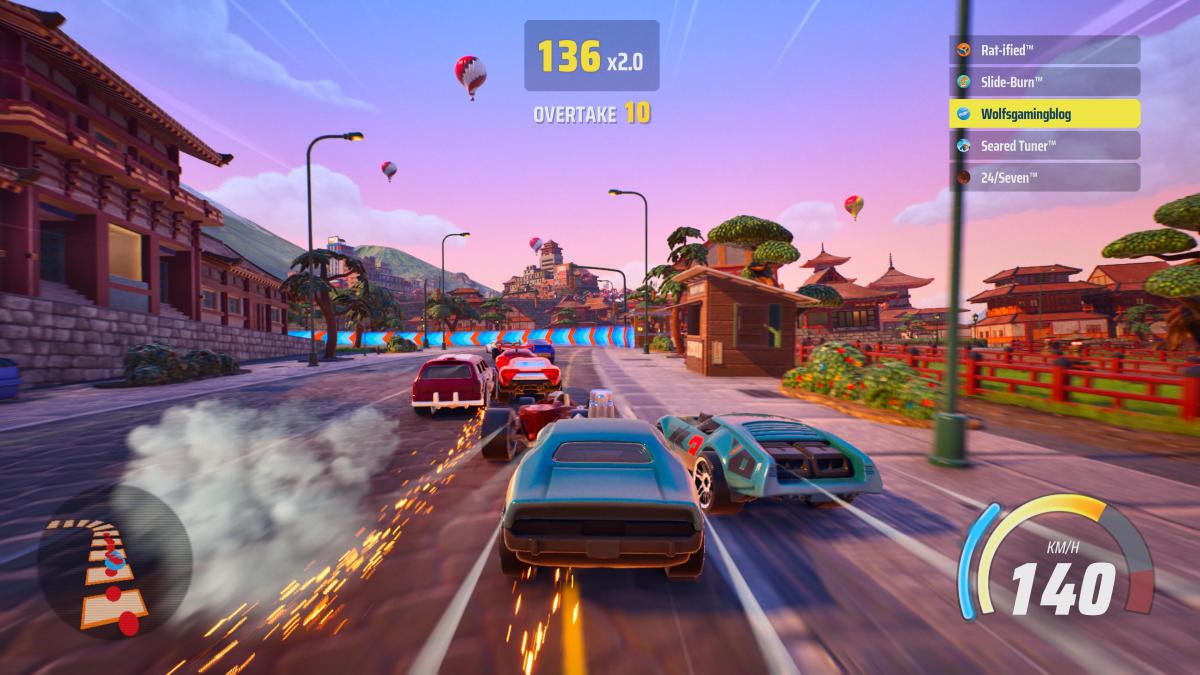
This does make the review a tad easier, because if you already like those games and wished they had open-world maps, Infinite Rush is for you. Good arcade racing, colourful action, a bit of room to explore and collect a bazillion collectables.
The actual act of driving your plastic portfolio still feels terrific. You hit the drift button to launch into controlled slides, build boost to reach stupid speeds and navigate the occasional obstacle, like something dropping boulders onto the track, boost zones frozen in ice or magnetic sections. The physics can be a little too enthusiastic when you clip something, but otherwise the action feels excellent. There’s a good sense of speed and drifting is fun, although the handling can become stiff and awkward whenever you’re moving slowly and trying to be precise.
Vehicles have been split into four classes in a bid to make them feel different and unique. They do exactly what you’d think: Drifters slide around corners like crazy and recharge boost in the process; the Speed class is all about top-end pace, while Versatile doesn’t do any single thing brilliantly but builds boost by doing just about anything. And then there’s the Titan class, the heavyweights that smash through scenery with ease…except all the other cars do that already. Seriously, you can ram through traffic, trees, fairly large stones, fences and a good chunk of the scenery without even slowing down, so the Titan’s main role is to be big, slow and bad at handling. Its boost does constantly recharge, but if you empty the bar the car splutters to a near-stop for a few seconds. Titan feels like the answer to a question Infinite Rush never asks.
You can toss on a few modifications as well, slotting upgrades into four spaces to alter handling, add more speed or improve boost generation. Nothing too exciting, but it’s nice to have. There’s also a livery editor, although you still can’t customise rides by swapping physical parts or anything, which I keep hoping for. I want a custom Hot Wheels, man.
At least the cars themselves continue to look superb, with materials and textures that genuinely sell them as bits of plastic and metal being thrashed around. Personally, I could do with fewer licensed Skylines and similar real-world cars, because the weirder fantasy designs are much more interesting, but it’s still a superb collection that would make my little nephew jealous.
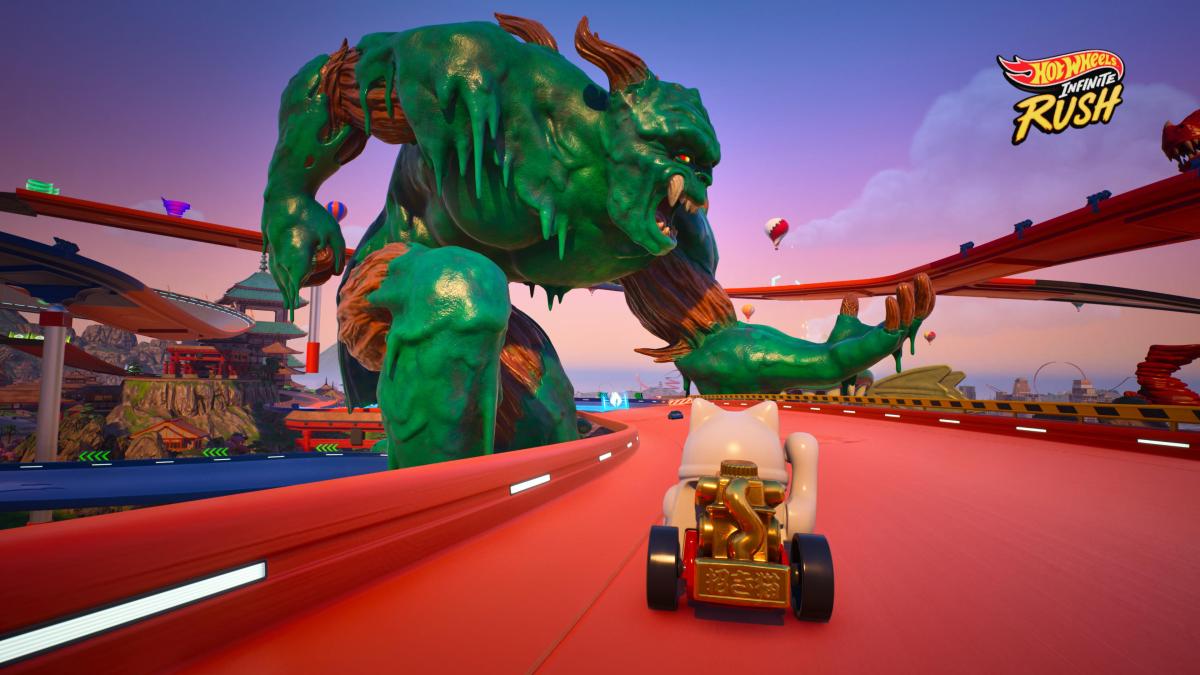
Infinite Rush doesn’t even pretend to have a story, which is kind of nice. Sure, I appreciate that Forza Horizon 6 attempts a narrative with a level of optimism usually reserved for all-you-can-eat buffets, but it’s…well, pretty shit. Instead, Infinite Rush drops you into the world, points you very vaguely towards races that fill a gauge to unlock the main Rusher events and then refuses to elaborate further. The only narrative thread is the one you tell yourself after crashing into a bloody wall for the fifth time that night.
The Rushers are essentially one-on-one boss races, with five to beat on each island. Early on, the game guides you around the four locations and has you defeat the first Rusher in each, then it loosens the reins and lets you tackle the rest however you want. The catch is that only races marked with a gold crown contribute towards unlocking the next one, and the amount required increases considerably each time. By the time I was working towards the fourth Rusher on a single island, I was already starting to feel done with the whole thing. If you want to beat the career, be prepared to spend a while doing it.
A major part of that grind comes from how narrow the progression is. Each circuit location acts as a racing hub, hosting standard races, eliminators and time trials on the same underlying course, but only specific crowned events move the Rusher meter. Everything else, including all the events outside of those hubs, either exists purely for fun or earns coins to spend on cars. It is easy to complete several optional races before noticing that the gauge hasn’t moved at all, while concentrating on the career makes the repeated tracks obvious very quickly.
The islands are also covered with Tourist Photos, drift challenges, Stuntman events, Speed Stunts, collectibles and other distractions. Find the Flame is one of the better examples, asking you to locate a pillar of fire somewhere in the world and reach it without much guidance, while Speed Stunts hand over unlimited boost and ask you to blast through checkpoints. There’s a decent variety of lightweight things to mess around with, but again, none of it contributes towards defeating the Rushers. You can spend an hour taking photos, hunting collectibles and completing stunts without moving one millimetre closer to finishing the career.
That probably won’t be such a problem if you’re a nice, normal gamer. Infinite Rush clearly wants you to roam around, pick whatever looks entertaining and treat the whole thing like a toybox. It just sucks at incentivising that. I like to beat a game, so time spent away from the crowned races felt like time in which I had made no progress. Letting every activity nudge the Rusher gauge forward would have encouraged me to enjoy the open world instead of making its contents feel like distractions from the actual career. Or, as a compromise, only let the side-events count for half the progression of crowned races.
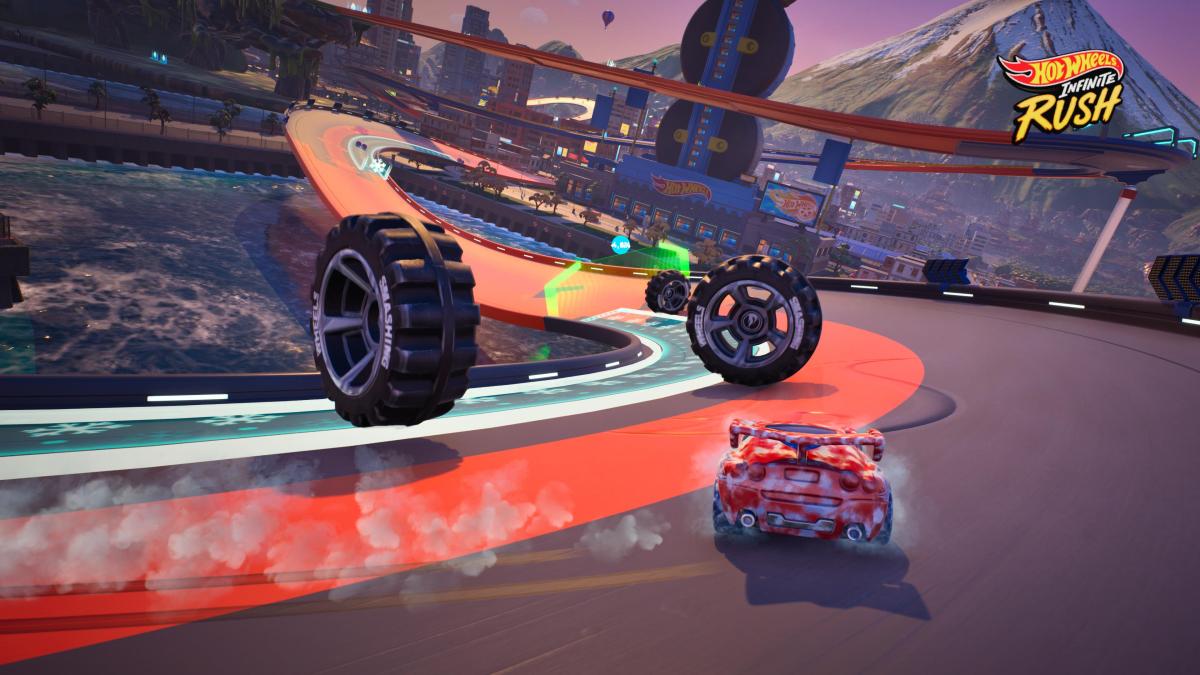
Instead of racing tiny cars through human-sized bedrooms, garages and skate parks as seen in Unleashed and Unleashed 2, Infinite Rush gives up that sense of scale for a world built entirely as a toybox. Its four islands mix open roads and urban areas with looping orange tracks that soar into the sky, while massive Hot Wheels playsets litter the landscape like somebody forgot to tidy up after a play session. The cars still look convincingly tiny and tactile, but something has been lost without the contrast of racing beneath chairs, over countertops and around ordinary objects.
More importantly, the open sections are pretty boring compared with the proper Hot Wheels bits, where you might tear through a loop or race past a dragon’s head spewing fire across the track. Infinite Rush can be weirdly reserved, often settling for dull layouts through generic scenery when it has the licence to build almost anything. The later Rusher races finally produce some of the spectacle I wanted, but it took too long to see the cooler playsets, branching routes or even deliberate shortcuts. Playing with Hot Wheels was about imagination as a kid, so it’s strange that Milestone still seems so in-the-box when designing tracks.
I think part of the problem is splitting everything into small chunks. Each island feels compact and small, and doesn’t have enough visual variety, whereas stitching them into one map could have created a better sense of scale as you travelled between distinct regions. One substantial world with more interesting environments joined by ridiculous orange constructions sounds far more appealing than four playgrounds in which the Hot Wheels pieces are doing most of the visual work because everything else is pretty bland.
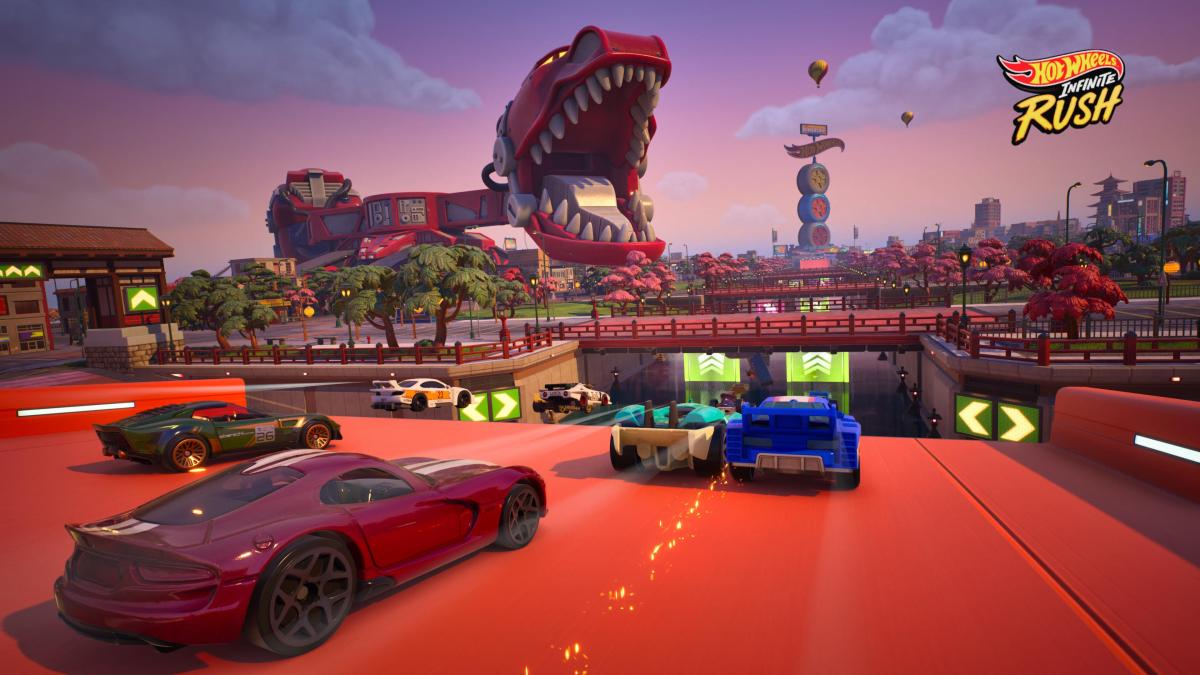
I also encountered a few problems with track readability. At one point, what appeared to be a choice between left or right sent me hurtling the wrong way. The open checkpoint events suffer too: a gate can look like it wants you to continue straight when there’s actually a sharp right turn immediately afterwards. Glancing at the minimap fixes it, but good track design should guide you without forcing you to look away from the road at stupid speeds.
The returning track editor provides another way to spend time away from the career and remains good fun, just as it was in the previous games. Multiplayer is present too, but before the review embargo there simply weren’t enough people available for me to test it properly, so I can’t say anything useful about how well it works in practice. It seems solid, and the previous games worked great, so I don’t forsee any issues.
In Conclusion…
Infinite Rush is built on a really good arcade racer, and when you’re drifting around a huge orange bend, boosting towards something gloriously stupid and watching a toy dragon breathe fire at the track, it’s hard not to have fun. The problem is everything wrapped around the racing. Its islands aren’t interesting enough to make exploration exciting, its best ideas are spread too thinly and the progression system discourages you from engaging with most of the map.
Unleashed 2 is still the better and more focused racer. Infinite Rush is the one to pick if you want more freedom, lots of icons to clear and a game you can dip into for a few races or some aimless goofing around. There’s plenty here, but dull environments, repeated tracks and the grindy Rusher structure keep its open-world experiment from being the upgrade it should have been.
 WGB
WGB 