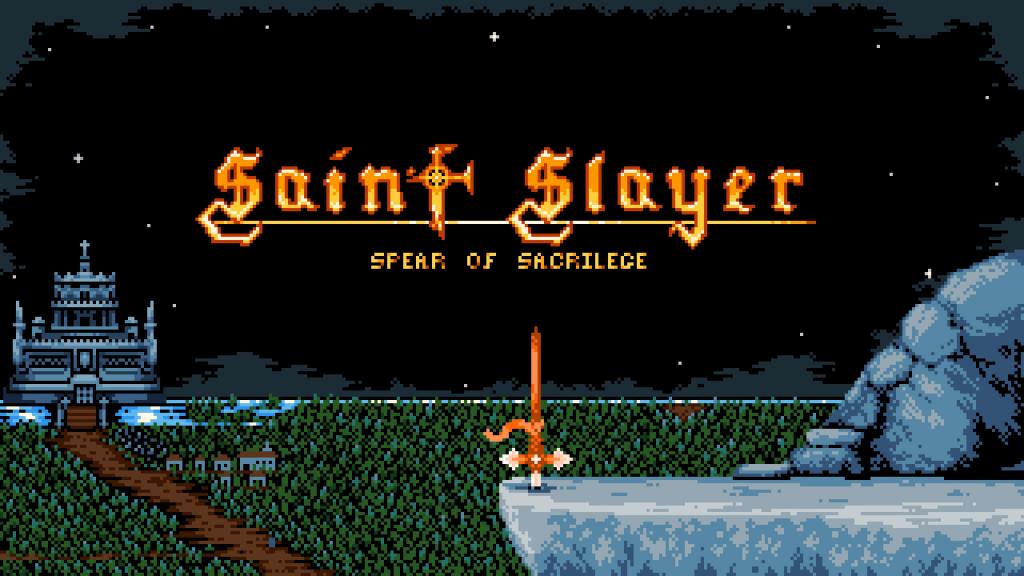
Saint Slayer: Spear of Sacrilege is a ridiculous, brilliant name—and the game behind it is just as committed to the bit: a gory, gothic throwback to when games were hard and gave zero shits about holding your hand. As developer Lilymo’s sixth title in their quest to replicate those days, the question is simple: is it their best? Arguably, yes.
Before diving in, I should probably address a potential bias. Lilymo is co-owned by Colin Moriarty, a former IGN writer turned podcaster whose work I actively follow and support. I like what he and the Sacred Symbols crew do—enough to support them on Patreon. I like what Lilymo stands for. And that meant I came into this wanting to love Saint Slayer.
Available On: PC, Xbox, Switch, PlayStation
Reviewed On: PS5
Developed By; Lilymo Games
Published By: Lilymo Games
Review code provided by Lilymo Games
Which is why it pains me to say this: I didn’t. Not on a personal level, anyway. And the truth is, that’s not the game’s fault—it’s mine. I’d like to say this just isn’t the game for me, but the reality is harsher than that. I’m just not the right person for the game. It came looking for a boss and it got me, someone who wanted to be able to revisit the olden days and found out he couldn’t.
This is a NES-ass NES game, and it plays by a completely different set of rules. It’s stiff, unforgiving, and demands a kind of rhythm that doesn’t come naturally if you didn’t grow up with it. As an early ’90s kid, the NES was already history. I was raised on the Sega Genesis and PlayStation, and it wasn’t until the Xbox 360 era that I really began to understand game design, how the industry worked, and cemented the hobby as my main love.
So yeah—I struggled. I got my ass whooped, my pride hurt.
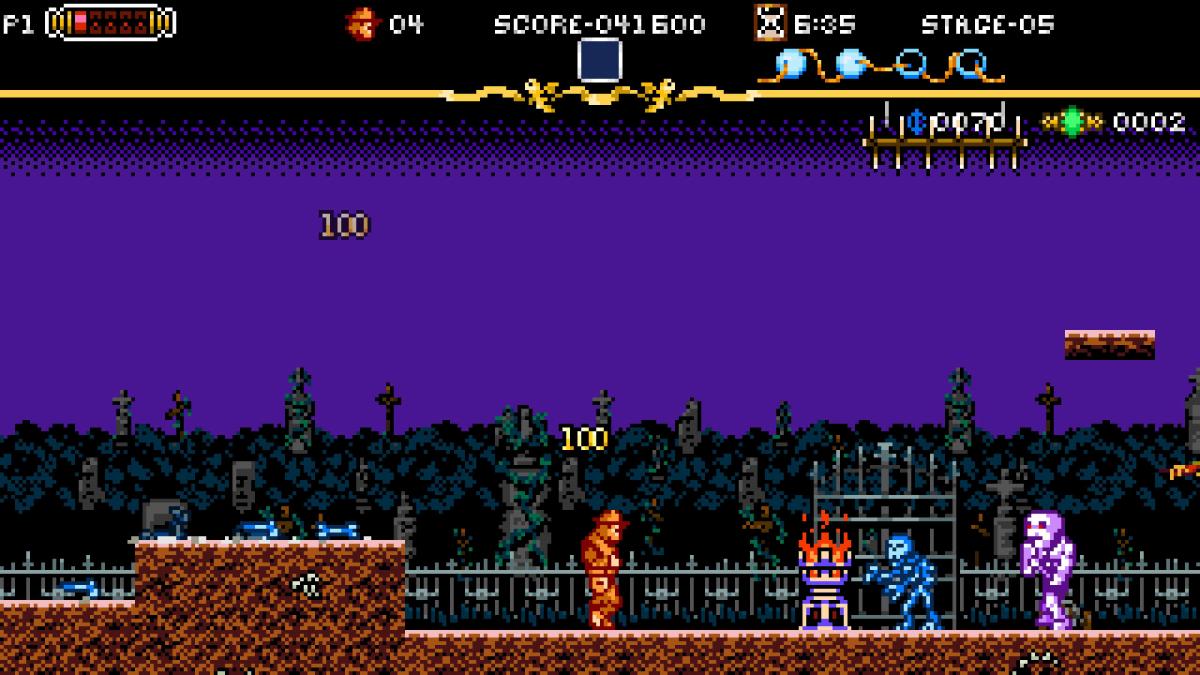
Playing Saint Slayer felt like trying to speak a language I don’t understand. I couldn’t settle into its rhythms, couldn’t read its patterns, couldn’t quite grasp what it wanted from me—even when the answer was obvious. My brain kept trying to translate it into something more modern. It doesn’t work like that.
And yet, despite all of this, I can confidently say: this is an excellent game.
And Now, The Review.
The story follows Rudiger, a former soldier turned farmer in a gothic version of late seventeenth-century Europe. But one day, tragedy comes knocking, and Rudiger sets out to defeat a crazed Catholic priest who is stealing relics and leading cults like he’s gunning for his own Netflix documentary. In the process, Rudiger ends up wielding the Spear of Sacrilege, a powerful poker that gradually gets powered up through the game. Cue 21 stages of platforming, combat, boss battles, gore, and weirdness.
The developers describe the game as a “blood-drenched homage to the 8-bit era of horror-tinged, side-scrolling action,” and that pretty much nails it. For every slightly wacky moment or tongue-in-cheek line of dialogue, there are bodies hanging from crucifixes, or messy piles of blood and bone. For every time you’re knocked off a cliff by a donkey or stab a weird monster in the eye, there’s rescuing barely alive prisoners from dungeons.
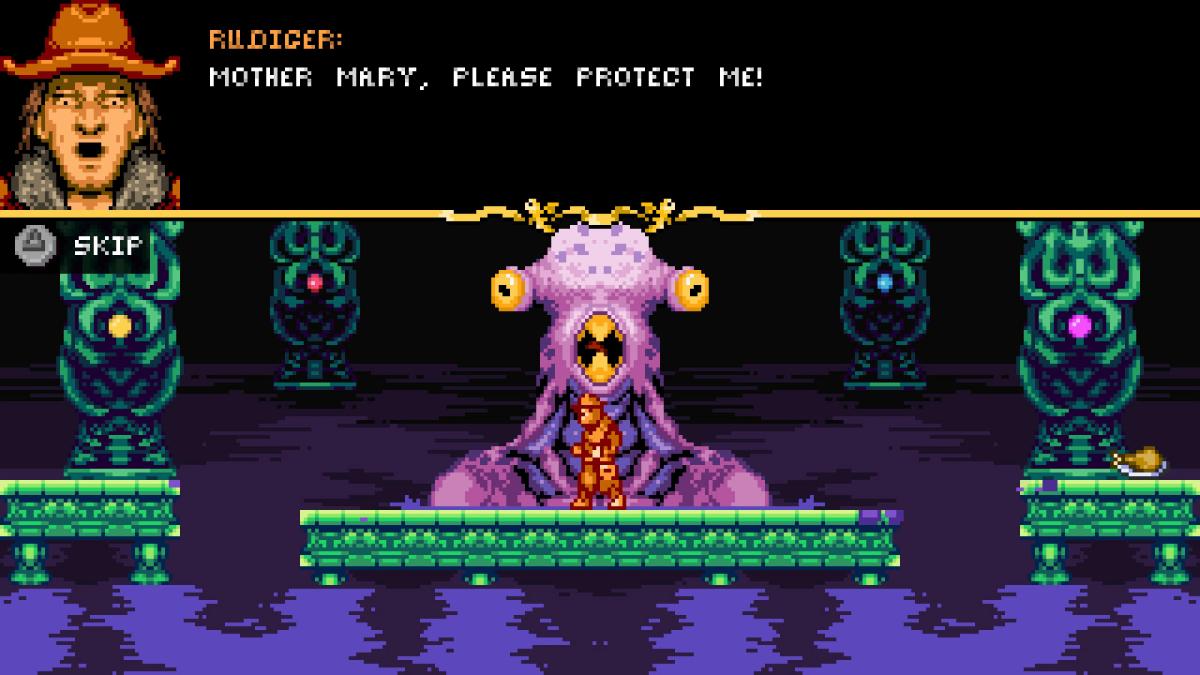
The other obvious inspiration is Castlevania, found in the level design, the gothic tone, and the gameplay. What feels stiff and unwieldy to modern sensibilities is entirely deliberate. You commit to jumps. Attacks have no lunge. Take damage, and the resulting pushback can send you straight into a pit and all the way to the start of the stage again. It’s punishing, but the rewarding kind that beats the shit out of you but is nice enough to call the ambulance afterwards.
I like how the game makes most of the story optional. The majority of the dialogue is a few lines here or there from bosses and NPCs you meet, painting in just enough of the background plot so that you can mentally fill in the gaps. But if you really want to delve into the story proper, you need to talk to the travelling merchant wherever possible, and see the different endings. It’s worth the extra effort, revealing a slim, interesting tale that does exactly what it needs to—be an excuse to move from stage to stage.
Rudiger has a simple moveset befitting his NES aspirations. He can stab hapless hooligans with his spear, or throw it provided he has enough Rosary Beads. A thrown spear can even be used as a climbing platform, a mechanic that could have been utilised a bit more, I reckon. He also has a DuckTales-style pogo stick bounce, another moment of absurdity. A few later upgrades add extra moves, putting Rudiger in real danger of becoming a competent human being.
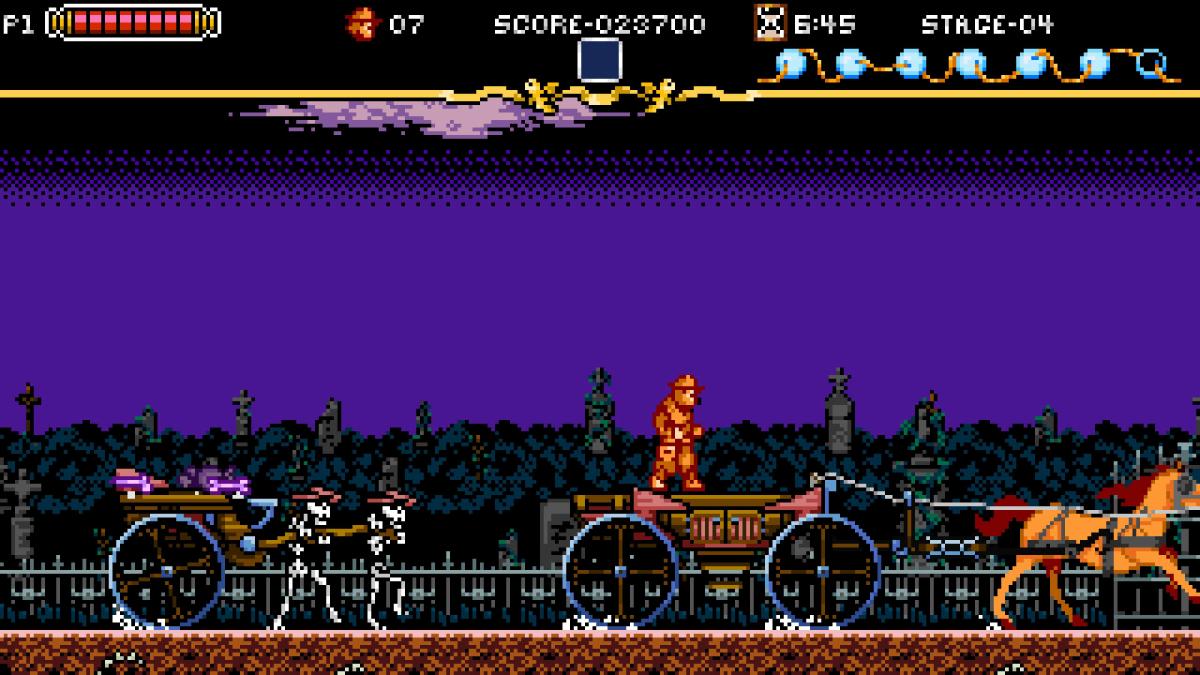
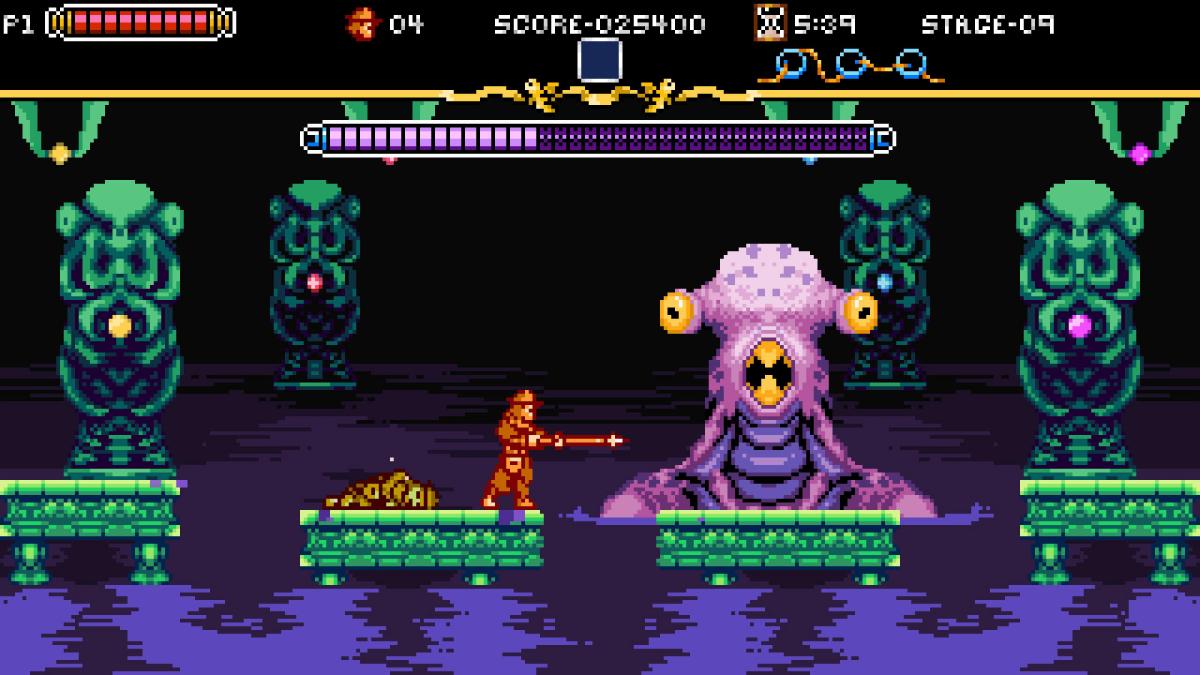
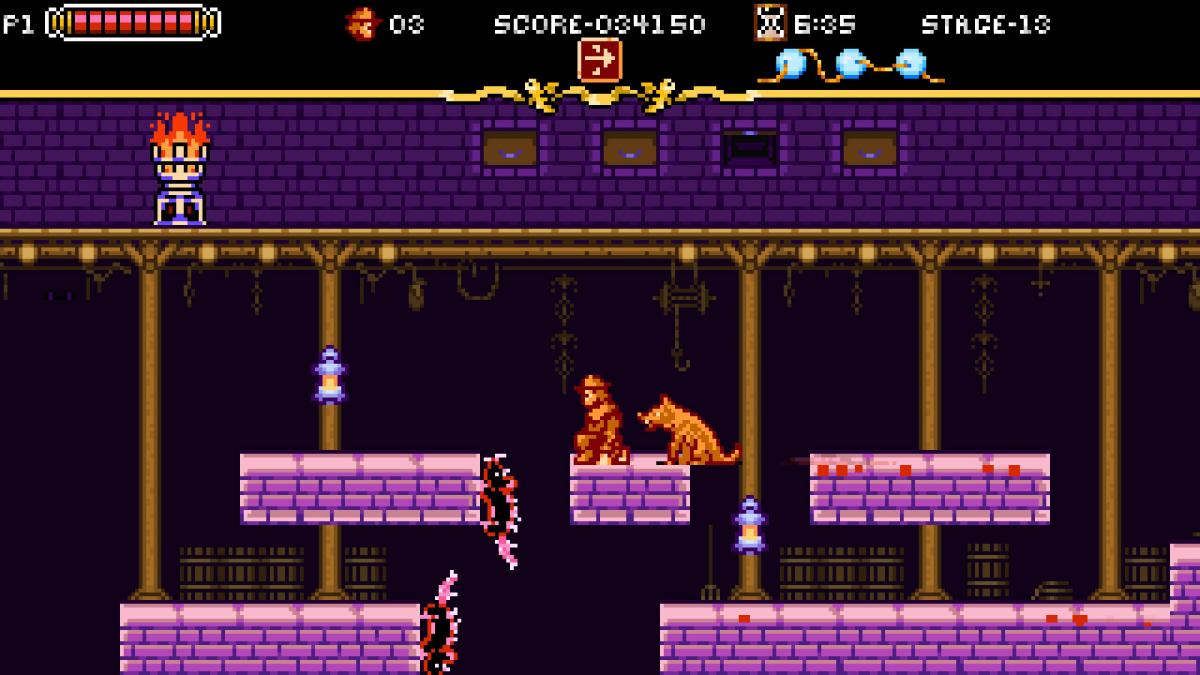
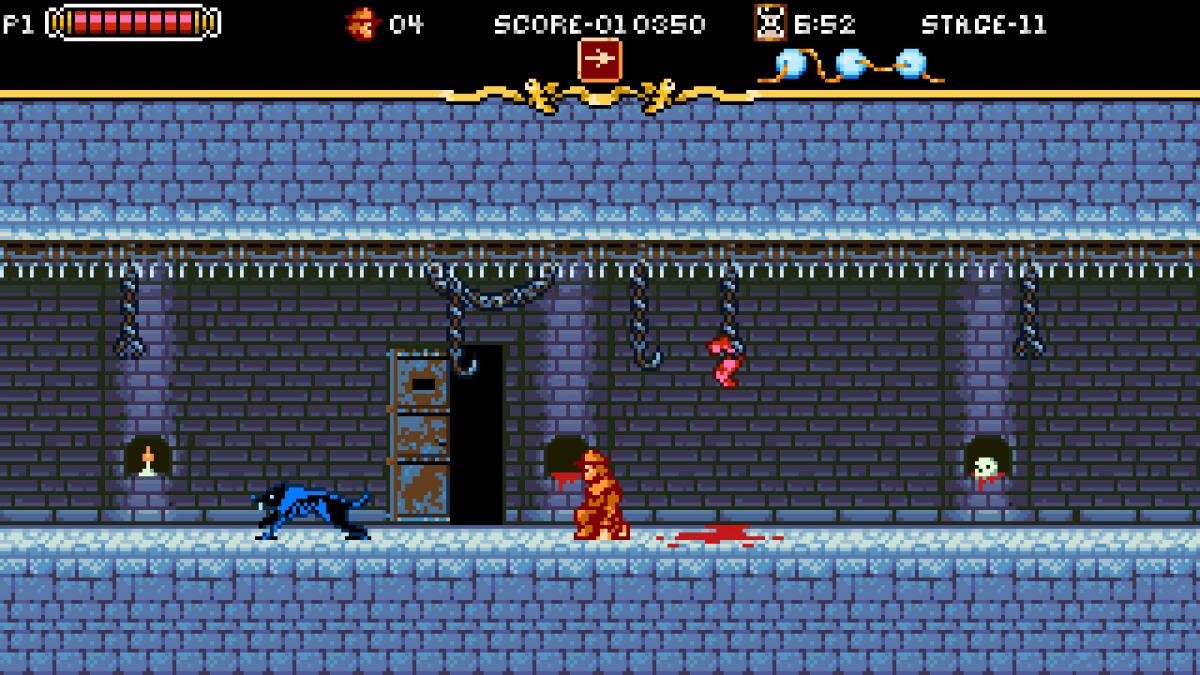
With this diet moveset, the devs craft a fiendish death trap that must be battled and survived. You need to learn the patterns, figure out when to attack and when to just ignore your problems and sidle onwards into the pixelated sunset. Success must first be earned through failure. Probably quite a bit of it, if you aren’t an old head.
Dropping down to the easiest difficulty will help quite a bit. You get extra health and the enemies die quicker, but the biggest difference is the lack of knockback. And for those looking for a challenge, Classic mode removes lives as well, so death means instant failure and a desire to punch the nearest object.
Lose all your lives and you’ll be given that stage’s password, which you can use to jump to that specific stage from the main menu. There’s a cost, though: you’ll spawn in fresh as a proverbial daisy with no health upgrades or anything else that you would have acquired by playing normally.
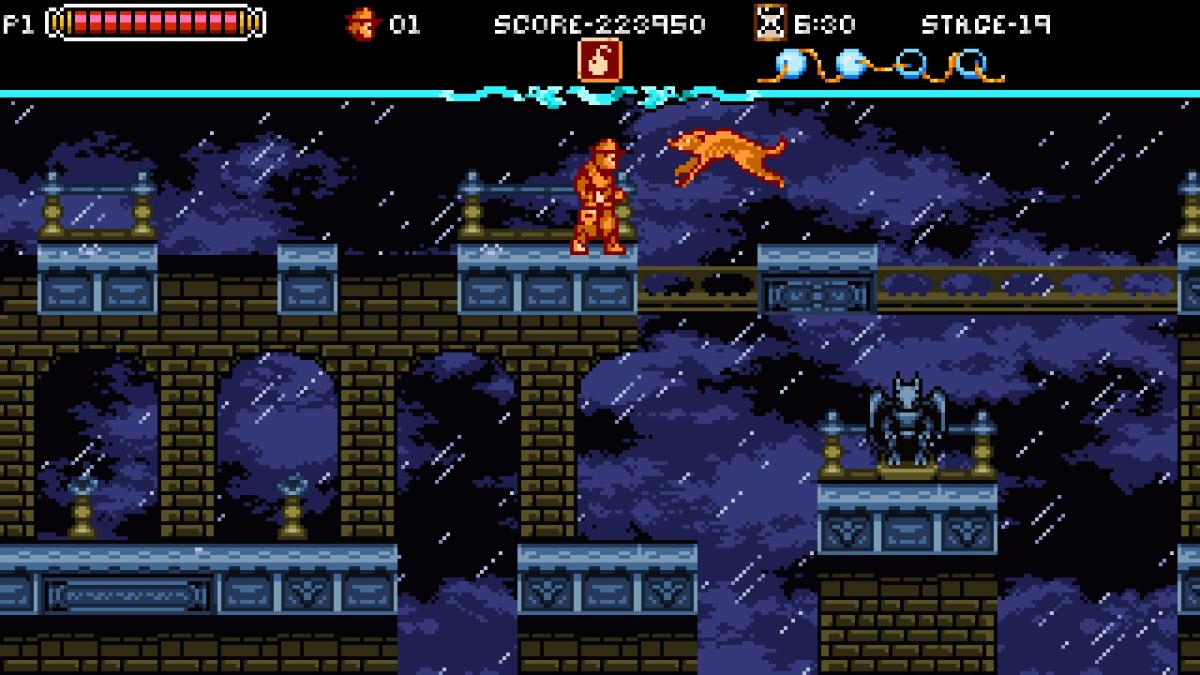
You also get passwords when you manage to locate the various treasures hidden throughout stages. These passwords are more fun because they unlock cool stuff that you can then use to run through the game again, or extra challenging modes. Want to play exclusively with Rudiger’s first-stage dirk that has the reach of a baby’s arm? You can! And who knows how many other passwords are waiting to be discovered?
There is a slightly more modern idea: a persistent currency called Orbs. These stick with you across playthroughs and can be spent at a travelling merchant. It’s an interesting system, but one I didn’t find very useful until much later in the game, where I hoarded Orbs until attempting a run on the harder difficulty. At that point, my trove of treasure helped a lot.
And if you’re still struggling, it is possible to farm Orbs pretty easily.
Speaking of the passwords and treasures, this is a game that’s intended to be replayed, again just like you would have done back in the NES days. There’s four different endings to achieve in Saint Slayer: Spear of Sacrilege, along with Trophies/Achievements for completing the game with the various treasure passwords and on all the difficulties.
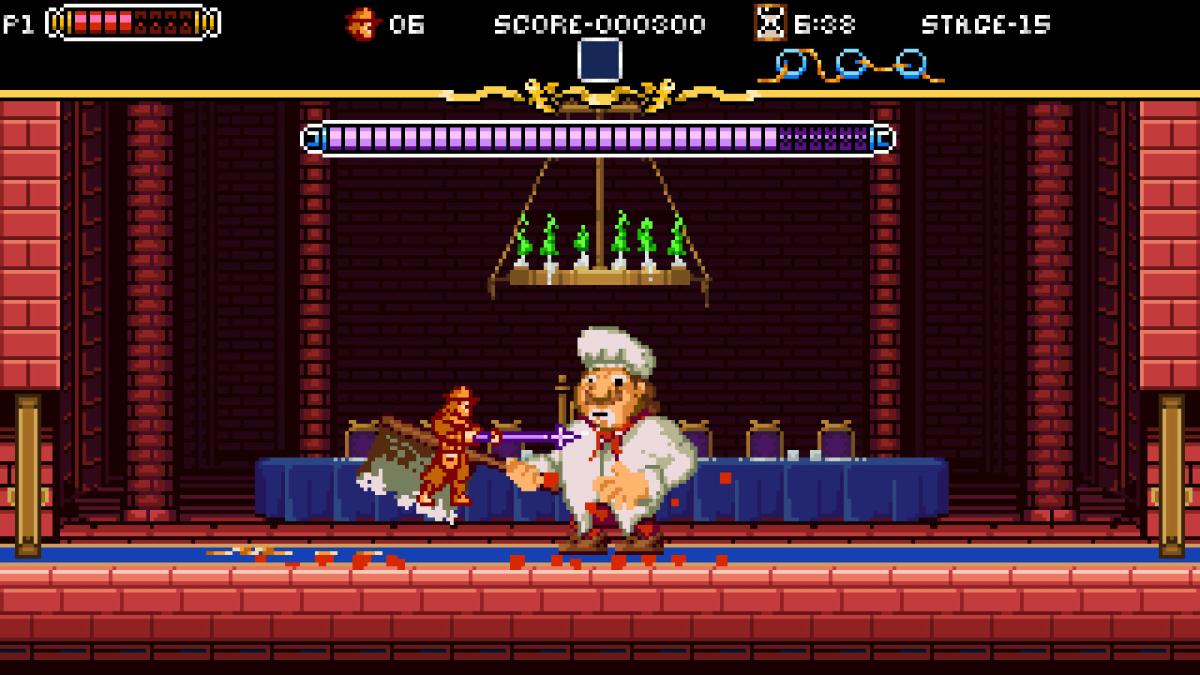
Again, it’s very Castlevania-coded. The first couple of playthroughs will be slow and clunky, but as you get the hang of the gameplay and map everything out, you’ll go from an hour or two to probably 15–30 minutes, if you really nail it.
You can also tackle the whole thing via local co-op. Yes, another Rudiger can take up the spear, and like most things, it’s even more fun with friends. Well, right up until you turn on friendly fire—then it’s a cause for shattered friendships and therapy.
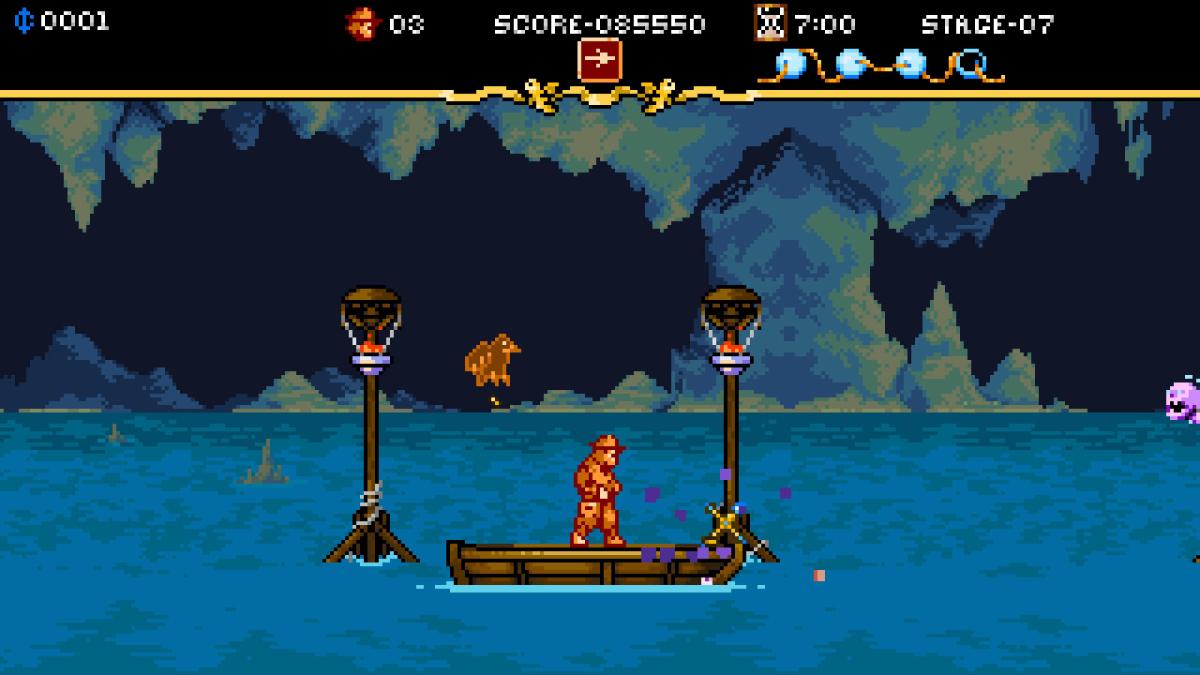
Presentation is an area where SS:SoS is excellent in every aspect. Do you see those pixels? Aren’t they lovely? The artist, Josh Gossage, does an excellent job of emulating the style of the time with a couple of modern touches here or there. My only complaint is one or two levels are quite plain or could do with a touch more variety.
Meanwhile, the score—composed by Josh Davis—is a banger. Again, perfectly retro to match the time period, with a couple of tracks that had me bopping my head along to the beat.
And finally, let’s throw a little extra kudos Lilymo’s way for their continued usage of Trophies. Previously, the company has offered up different levels of Trophy difficulty for their titles: easier on PS4 and harder on the PS5 versions. This time around, they opted to ditch the difficulty and instead just have two different Trophy lists, each one sharing some Trophies while also having some completely different ones, too. It should make it fun to chase the Platinum on both versions of the game.
In Conclusion….
The obvious negative is that SS:SoS is so dedicated to its inspirations that it doesn’t do anything particularly new. But that’s not much of a criticism. It isn’t trying to be shiny and new. It wants to be a game that could have been released during the NES days, and it succeeds wildly at that task.
There’s a couple of levels that overstay their welcome, some of the deaths felt a bit cheap, and then there’s my own personal issues.
None of them detract from how much of a fitting, touching homage to the classics Saint Slayer: Spear of Sacrilege is. It is not for everyone—it isn’t for me—and that’s exactly how it should be.