
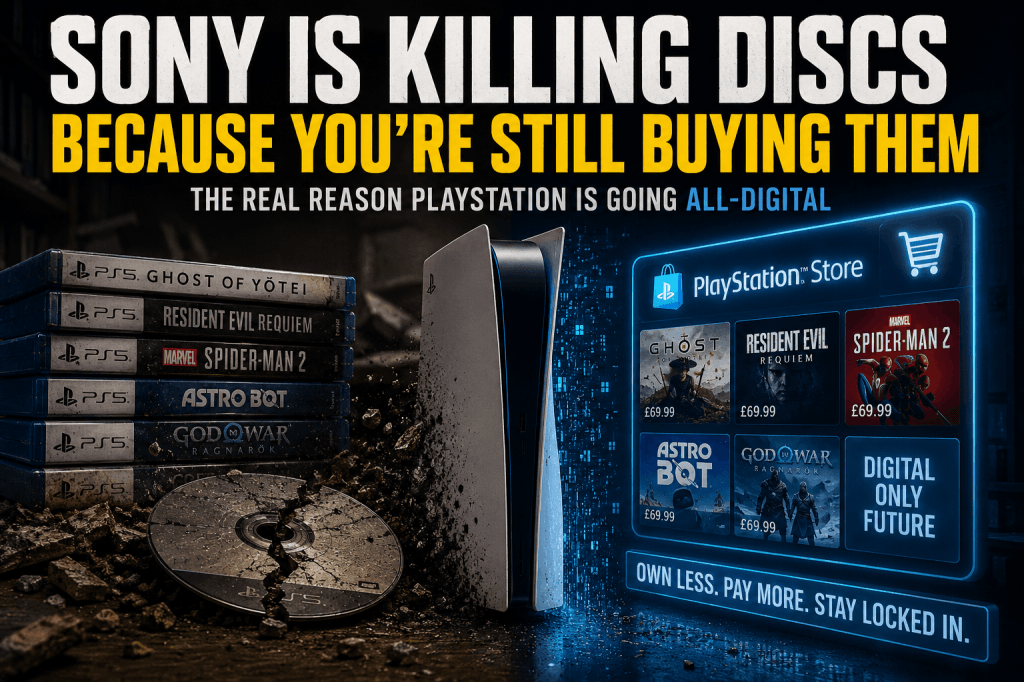
Well, well, well. Sony is certainly having an interesting week, isn’t it?
Having announced that, as of January 2028, it will stop producing physical PlayStation game discs, the company proceeded to go on a social media blackout, presumably because it knew the backlash was coming.
Oh, and what a backlash it has been. The internet is no stranger to a good old-fashioned frenzy, but this one kind of takes the cake. And biscuits. And the silverware. Big companies, celebrities, politicians and pretty much every account with a keyboard have been getting in on the action, all piling onto Sony’s decision to stop making physical games and, in the process, basically announcing that the PS6 will be a digital-only console.
The logic behind Sony’s decision seems simple and clear-cut. Games are moving towards digital, and so are gamers. They’re not wrong. The writing has been on the wall for years.
But just because we all knew it was coming does not make it suck any less.
Sony’s own data claims that, in FY2025, 78% of all full-game PS4 and PS5 software sales were digital, rising to 85% digital in Q4 of that same year. That sounds decisive. But when you start delving into the data, the picture becomes a lot more interesting and nebulous.
You see, Sony’s numbers are correct, but they also include games from across the board. That means they include games that were never released physically in the first place. And indeed, a huge number of games released every year never see a physical release at all, purely because of the cost. Most indie games, for example, will never get a boxed version, not unless they happen to sell a few million copies and earn themselves a nice fat Limited Run Games cheque in the process.
When we start delving into specific numbers, though, the story becomes a lot more interesting, especially for Sony itself, because it turns out its first-party games still seem to have a very large physical audience.
So, let’s talk about that data, shall we?
First of all, we have a new batch from Alinea Analytics and Rhys Elliott, who shared a bunch of fresh sales estimates. Some of it is roughly what you would expect. FC 26 is the best-selling game on PlayStation of the year so far by copies sold, and only around 12% of those sales were physical.
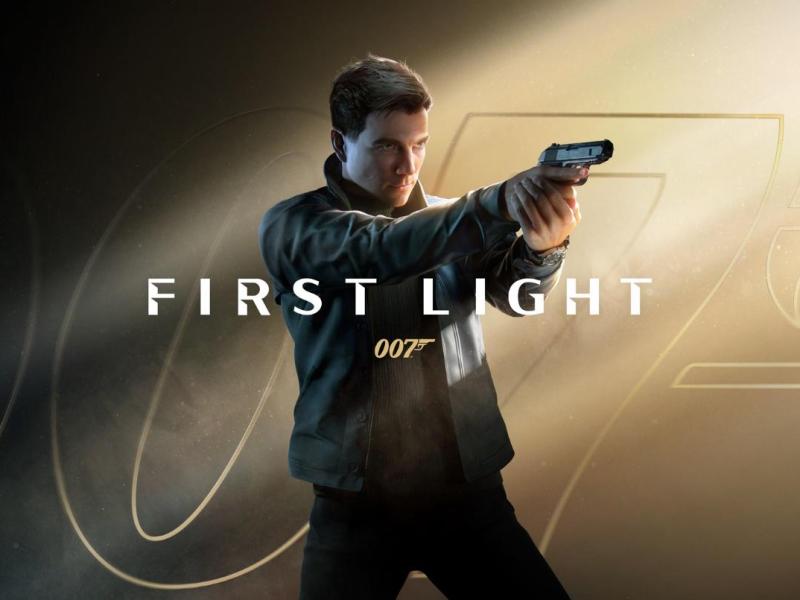
007 First Light Review – From Hitman With Love
After decades of hit-and-miss videogame outings, James Bond finally has a game worthy of his licence to kill. 007 First Light blends explosive action, clever stealth and all the spy gadgetry you could ask for into a thrilling adventure, but its greatest achievement is creating a new Bond who feels like he’s been part of…

007 First Light, meanwhile, has sold 2 million copies on PlayStation 5, with around 21% of those being physical.
Again, those figures broadly line up with PlayStation’s own numbers. But that’s when we get to something very interesting.
First up, we have Resident Evil Requiem. According to Alinea, it has sold 3.5 million copies on PS5, with 27.8% of those being physical.
And then we have the real news: Ghost of Yotei. A Sony first-party game. A PlayStation flagship title. It sold another 1.2 million copies so far this year, and of those 1.2 million copies, a staggering 35.4% were physical.
If we venture further beyond Alinea’s figures, there have also been reports of Astro Bot selling 55% physically in the UK, and nearly 60% physically across Europe as a whole. Spider-Man 2, meanwhile, was reportedly at 54% physical sales in the UK, although that figure includes bundles. Of course, these are slightly older games – even a few years makes a different in the shift from physical to digital.
It’s not that Sony’s numbers are wrong. They aren’t. It’s just that broad numbers can be very good at hiding the interesting details. And when you start looking at those details from another perspective, we find that Sony’s own games seem to have a very large physical audience.
Which leads us to a simple question: if physical games still make up a meaningful portion of sales for some of PlayStation’s biggest titles, why would Sony want to ditch them entirely?
The simple answer is that Sony isn’t killing physical games because people are not buying them. It is killing physical games because people are buying them.

This is the moment Sony and Xbox have been waiting for. Not because physical games have vanished, but because digital sales are finally dominant enough that the platform holders can justify pulling the trigger.
Before, killing the disc would have looked absurdly hostile. Now, they can dress it up as inevitability. They can point at the stats, shrug dramatically, and say the players already chose this future.
And to some extent, we did.
But that does not mean Sony is merely following the market. It means the market has finally moved far enough for Sony to finish the job.
Publishers, developers and console manufacturers have been pushing for a digital-only future for years now. Just look at the disastrous Xbox One launch, with Microsoft’s infamous plans to make trading your games even harder. Why? Because games you can trade and resell mean money that is not flowing directly back to the platform.
If you go and buy the latest Sony first-party title for $70, then sell it on eBay afterwards for someone else to buy for $40, Sony does not see any of that $40. Nor does it see any of the $30 from the next eBay sale, or the $20 from the sale after that. That one game has now passed through four or five people, and Sony has not seen a single cent from any of them beyond the original purchase.
This is the nature of physical games. For consumers, they are a fantastic option. We can buy them, store them on shelves where they look pretty and add to our collections. We can lend them to friends so they can experience the same joy we did. Or, as many people do, myself included, we can sell them on places like eBay to help fund the next big game and keep the addiction fed for one more day.
This also ties into Rhys Elliott’s flywheel theory.
Elliott notes that catalogue revenue is a big deal. Huge, in fact. Ghost of Yotei is still selling well months after launch. Resident Evil Requiem seems likely to keep going and going. And Capcom, in particular, makes a lot of money from back-catalogue sales, especially on PC.
Sony likely wants that same kind of flywheel on PlayStation.
The flywheel idea is simple: launch the game, keep selling it digitally for years, discount it when useful, bundle it, promote sequels, bring new players into the series, and keep all of it inside the platform storefront.
And you can certainly see the appeal from Sony’s perspective. When physical games are not there dragging the potential price down, Sony can keep the cost much higher for players.
“Look,” they can say, “we’ve discounted it.”
But in reality, that discount might only be $10 or $20, versus the $30, $40 or $50 discount you might have found by buying it physically. Then, when a sequel is announced, Sony can drop the price of the first game again by a few more dollars, pull a few more people into the series, and let the whole machine keep spinning.
And spinning.
And spinning.

There is also the fact that the original sales pitch for digital games was kind of a lie.
When digital games first started becoming more mainstream, they seemed like a great and interesting option. Here was something more convenient for users. You could simply go online, hit a button, download the game and start playing. And indeed, that has become true. Most people these days would clearly prefer to just hit the buy button on their console and get on with it.
But when digital games were first being pushed, we were told, often, that they would be cheaper. By cutting out the middleman, you would no longer have to pay for games to be shipped to stores, stored in warehouses, kept on shelves, or account for the cut that physical retailers would have to take. Therefore, digital games should be cheaper.
That turned out to be a complete lie.
In most cases now, digital games are, in fact, far more expensive. You can go online and find almost any standard $70 AAA release and typically buy the physical version for $10 to $15 less. Here in the UK, where most games now retail digitally at £69.99, I can usually wander onto Amazon and buy a physical copy for around £60. So I have already saved £10.
Then, when I am finished with it, I can sell it. For a short single-player game, I can usually finish it within a week and resell it for £40 or even £50, getting most of my money back to put towards the next game.
So yes, the pitch for digital games was somewhat of a lie, and it also came with one massive inconvenience: you do not own the game. You own a licence to access the game. And licences can be revoked for a myriad of reasons. Sometimes just because you sneezed.
At least with a physical game, you could always stick the disc in and play, even if the console was offline. Even if the company decided it simply did not like your account anymore, you still had the disc. You could still play it.
But now, of course, the entire game is rarely ever on the disc. Massive day-one updates required to make games playable are commonplace. Or you have something like Grand Theft Auto 6 waltzing in and announcing, “Hey, you’re getting a code in a box. Isn’t that fun?”
No. It’s not.
But I guess at least I have the box to stick on my shelf. That’s something.
Sony is moving us into an all-digital future. As we have already said, the writing has been on the wall for a long time. This is not a surprise.
And worst of all, we have done this to ourselves.
Digital game sales have been rising for years, and publishers, console manufacturers and every other business involved have not had to force that change. We did it ourselves because digital games are convenient. Press a button, spend some money, download the game, never leave your house, and have it ready to go at midnight on launch day.
That convenience has been enough.
But the truth is, Sony is not getting rid of physical discs because nobody is buying them. We can see in the data that people are. Hell, even using Sony’s own numbers, if 15% of full-game sales are still physical in a quarter, that is still a lot of copies. That is still a lot of players.
And as we can see from the numbers, Sony’s own player base still seems to like physical games. It is just that Sony, and Xbox, which is now reportedly also heading away from disc drives, do not want physical games.
They do not want that secondary market.
From a business perspective, it makes no sense. It is just good for consumers. And companies care about what is good for the consumer right up until it conflicts with what is good for the business.
From a player’s perspective, a used copy is a bargain. From Sony’s perspective, it is money escaping the ecosystem, legging it out the front door, never to be seen again.
Sony does not just want to sell you a game. It wants to sell you the whole store, the whole ecosystem, and make sure you never leave it.
The bad news is, it’s too late.
No amount of backlash is going to stop this. And indeed, the backlash we are seeing online is probably largely fake.
Fake might be a strong word for it. We see people get angry about things all the time online, but it rarely ever translates into reality. I have no doubt that the people online are as angry as they seem, but I also have no doubt that this anger is going to fade quickly and die out. There’s always a new thing to be pissed off about.
In reality, this transition is barely going to affect the vast majority of people, because they already buy digitally anyway and do not really care.
Look at all the other things we have been angry about over the years, whether it was horse armour, microtransactions, always-online games, $70 games, $80 games, live-service overload, or digital-only consoles. Wait. No. That’s now. Anyway, we have been here before. We have done this before. And it is not going to change this time either.
But that does not mean we do not get to feel sad about it, mourn it, and wish things were different. You can understand that the future is digital, and still be angry that the option to have a disc is being taken away.



 WGB
WGB 