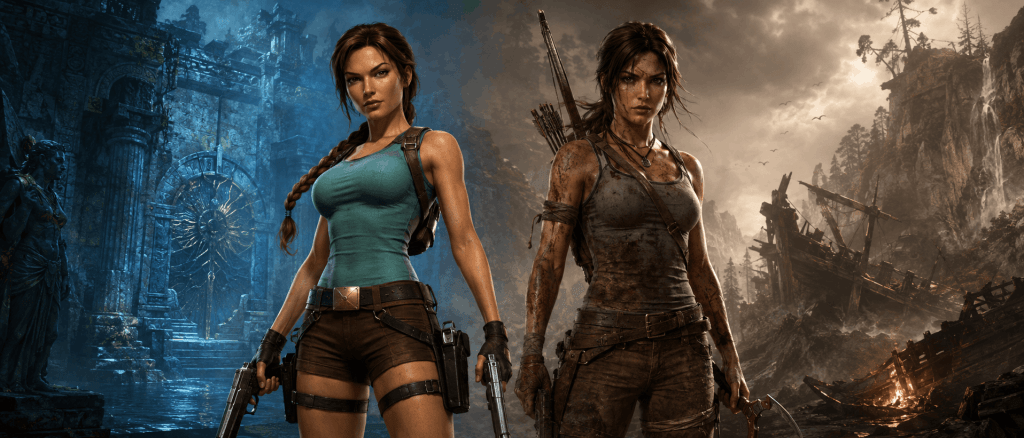
Speaking to IGN, the developers of Tomb Raider: Legacy of Atlantis confirmed that the upcoming reimagining of Lara Croft’s original adventure is not set in a separate continuity from the modern Survivor trilogy.
Asked directly whether the game exists in its own independent universe, Jeff Adams, Experience Director at Crystal Dynamics, said: “No, the events of the Survivor series did occur and this is the same [Lara] in the same universe, but we are finding her at this point in her career.”
Earlier in the interview, the team explained that while Lara’s Survivor-era adventures remain part of her past, Legacy of Atlantis is focused on a different stage of her life: “Lara has [the] Survivor series in her past, but she is not beholden to it in Legacy of Atlantis. So, we are finding [Lara] at a particular point in her career where you are seeing her in her prime and that’s what we’re focusing on for this experience.”
In other words, the Survivor trilogy still seems to function as Lara’s origin story in this new/modernised continuity. Those events happened, that version of Lara went through hell, and Legacy of Atlantis is picking up with someone who has already been shaped by those experiences. But crucially, the team does not appear to be making a direct sequel to Shadow of the Tomb Raider, either.
Listening to the full interview, it seems clear that while there is going to be a link between the Survivor games and the reimagining, and perhaps even some references — like how Lara now uses a grappling hook — these are still going to be mostly separate adventures. It’s just that if you already played the brutal Survivor games, you’ll have more context for who Lara is and where she came from.
Basically, while there is a continuity link, it doesn’t sound like there’s much focus being put on it within the story itself. Crystal Dynamics seems more interested in presenting Lara as the fully formed adventurer fans remember from the classic games, rather than constantly dragging the Survivor trilogy’s trauma and tone behind her like an emotional backpack full of climbing axes.
But game design is another story entirely, because interestingly, the team also seems to be drawing from the design language of the Survivor trilogy, not just folding those games into the wider canon. When discussing the famous T-Rex encounter from the original Tomb Raider, one developer explained that the goal was to preserve the memory of that moment while turning it into something more cinematic and substantial.
Rather than simply recreating the T-Rex as a large enemy Lara shoots until it falls over, the team wanted to give it “more screen time” and turn it into “a longer sequence.” To do that, they looked at the Survivor trilogy, where Crystal Dynamics became rather fond of having Lara sprint away from collapsing tombs, floods, avalanches, bears, and any other form of natural disaster that fancied ruining her day.
“Looking at some of the stuff that we did with the Survivor trilogy,” Raul Siqueira, Game Director at Crystal Dynamics, said, “when we got really good at making Lara run away from avalanches, floods, bears, and all the other things. Those two were a very good marriage.”