UPDATE, Nov 1st: We’ve now got far more reliable clarity on where the $500 million budget number came from.
Former Senior Product Manager Derek Reese posted on BlueSky, confirming that the $500 million budget was the running cost for The Coalition as a whole.
“So much of that cost is The Coalition being on the hook for the Microsoft branch of Unreal and one of the flagship titles,” wrote Reese. “I should know, I tried to get leadership to support a plan to have other studios adopt it and write off the support costs. Same problem with Turn10 and ForzaTech.”
The Coalition handles a lot of support work for other teams. As the main keepers of Unreal Engine 5 for Microsoft, The Coalition lent a lot of support to the likes of Avowed, State of Decay 3 and Hellblade 2, for example, while also maintaining the version of Unreal 5 that is used across multiple Xbox teams.
The $500 million is absolutely a real cost that The Coalition is on the hook for, but it is it not the budget of Gears of War: E-Day itself. Unfortunately, Reese did not provide a better estimate for how much the game itself cost, although that’s likely pretty hard to determine for anyone except the people directly involved with the money side of things.
Interestingly, Reese also says he was involved in trying to get the other studios to adopt the technology – basically maintaining their own versions – and therfore write off The Coalition’s costs, because on paper $500 million makes The Coaltion look incredibly expensive. It doesn’t seem like he had any luck, though.
UPDATE:, 30th Oct: On his latest video on his Youtube channel, Bloomberg journalist and knower of many mysterious things Jason Schreier has weighed in to say that Gears of War: E-Day did indeed cost $500 million to make.
Discussing the closure of Bioware, Schreier commented on the massive budget of E-Day, stating: “…we just saw Gears of War E-Day cost $500 million to Xbox and that is a real number. That is real. That’s what we’re looking at here. That’s what games cost to make, especially in North America these days, and it’s driving these game companies to to make layoffs, to do cost cutting, to move development outside of North America in a lot of cases, and to focus only on the biggest franchises that are as have as little risk as possible.”
UPDATE, 29th Oct: Tom Warren of The Verge released a new article with quite a few interesting stories within it. He also briefly touched upon Gears of War: E-Day, mentioning Kotaku’s claim’s of a $500 million budget. He does not confirm or deny that number, but does give us some news sales data to consider. According to a source, E-Day has now sold 400,000 copies across Xbox and Steam.
As a point of comparison, Gears of War: Reloaded sold 365,000 copies on PlayStation alone. That’s important because according to multiple reports, there’s a PS5 edition of Gears of War: E-Day that was going to be released until Xbox changed tactic.
Unfortunately, Warren cannot confirm whether Xbox is happy with E-Day’s Game Pass performance.
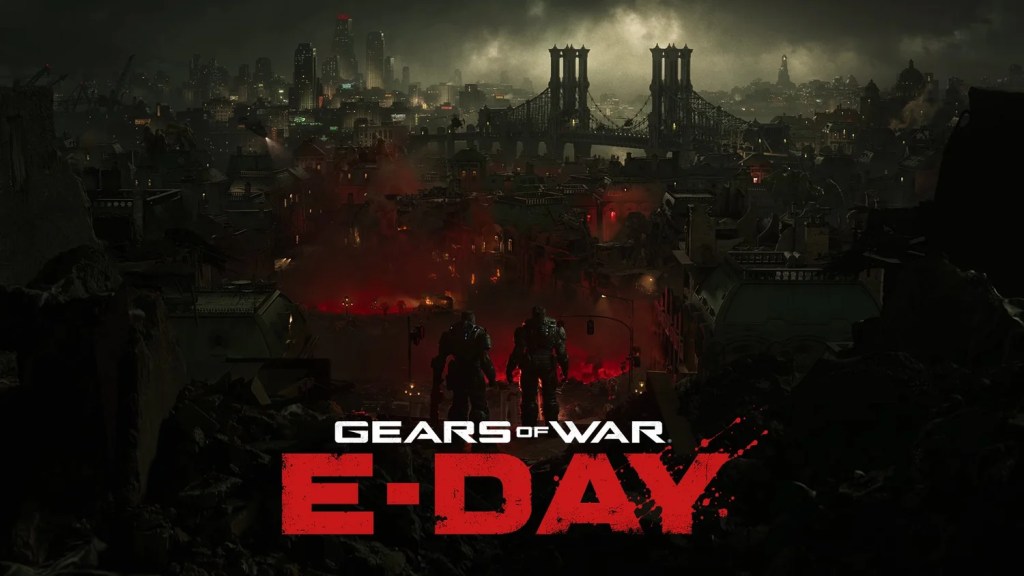
ORIGINAL STORY: Gears of War: E-Day reportedly cost more than $500 million, excluding marketing. That’s a hell of a sum, but according to a new report that’s exactly what was spent on bringing Marcus and Dom back.
The figure comes from Kotaku’s Ethan Gach, citing just one unnamed source familiar with Xbox’s business. Microsoft didn’t respond to the outlet’s request for comment, and the report provides no breakdown of the costs, which makes things a bit trickier.
This follows Tom Henderson’s claim back in June that he had heard E-Day’s budget was upwards of $400 million. Speaking on the Insider Gaming podcast, Henderson described the figure as “insane.” At the time, it wasn’t clear whether that amount included marketing or other expenses.
However, Windows Central’s Jez Corden disputed Henderson’s claims. Corden said on the Xbox Two podcast that E-Day “didn’t cost $400 million,” pointing to The Coalition’s work beyond its own games. Corden said that the studio is the “technological glue for all of Xbox,” arguing that its work on development tools, Unreal Engine and support for other projects meant some of that expenditure was spread across Xbox’s wider portfolio. In his view, treating it all as the budget for E-Day was misleading.
Of course, tools and overheads are legitimate development expenses. Something built or bought for one game can also end up being used on the next, and that doesn’t automatically mean it should be removed from the first game’s budget. Trying to untangle every reusable piece of technology would send us down a very long, very boring emergence hole.
The more relevant distinction is between money spent making E-Day and money spent helping other Xbox teams with their own projects. If Corden’s explanation is accurate, we can’t simply assume every dollar spent at The Coalition belongs to Gears or that it wasn’t viewed as a worthwhile expendature because the tech would be used in multiple other games across Xbox. For example, Xbox may have signed off on creating a horrendously expensive new tool for E-Day because they also knew that same tool could help out multiple projects in the future. Technically, that tool would still fall under E-Day’s budget, but it’s not quite so cut and dry as that.
The sales picture adds another complication. Alinea Analytics’ Rhys Elliott estimated on October 9 that E-Day had sold 230,000 copies since its October 1 advance-access launch, with 168,000 on Steam and 62,000 across Xbox console and PC.
Alinea also estimated that 1.7 million people had accessed the game through Game Pass, including 722,000 who paid for the $30 Premium Edition upgrade. Including those upgrades, estimated revenue reached roughly $37 million, meaning the number of people who paid something for E-Day was considerably larger than the full-game sales figure suggests.
But that’s still a long ways off of recouping the massive developement budget Gach is claiming his sources told him about. Indeed, Gach said his source noted that E-Day would be unlikely to ever recoup its costs regardless of what platforms it shipped on, but as an exclusive would be expected to contributue to rebuilding user activity on Game Pass.
So while it’s hard to get a completely accurate number, it does look like we can safely say E-Day had a monstrous budget, one that puts it at the very top of the triple-A space. What we don’t know is whether Xbox will deem it to be money well spent.