Stephen Totilo recently shared a chart on his Game File substack showing Sony’s first-party game sales by fiscal year. The chart, which comes from Sony’s own financial reports and the combined into one piece of data by Totilo, paints a pretty stark picture: first-party software sales have fallen from a high of 58.4 million units in FY20 to 32.1 million units in FY25.
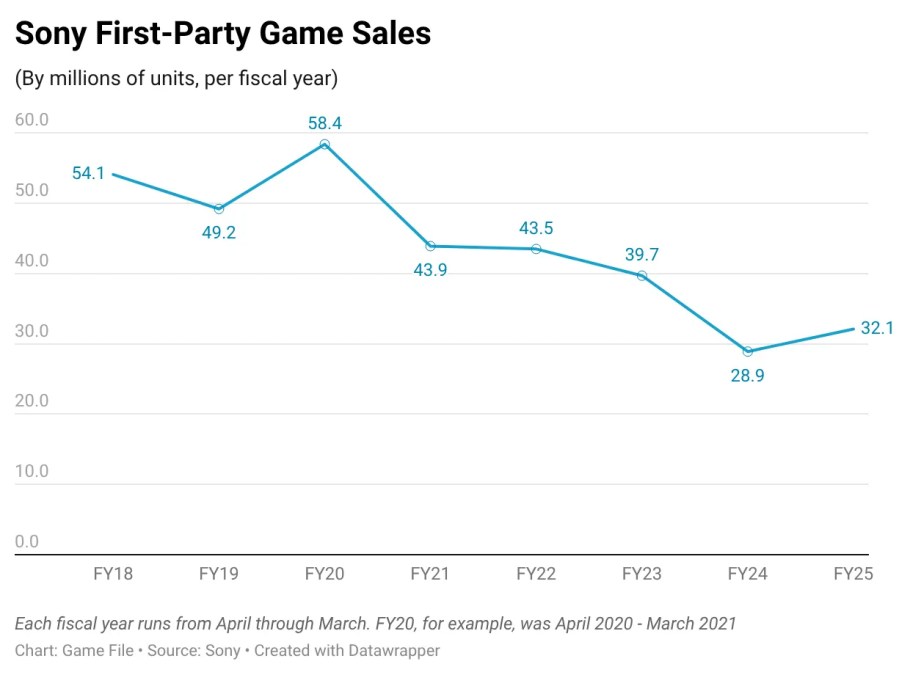
Needless to say, the chart quickly spread across social media, where plenty of people were eager to use it as evidence that PlayStation’s first-party strategy is failing, that gamers have lost interest in Sony’s exclusives, or that modern PlayStation games simply aren’t as good as they used to be. And honestly, all of those arguments have some merit to them.
The problem is that a chart on its own doesn’t tell the whole story. To be clear, Totilo’s full article is currently behind a paywall, so I can’t see what conclusions he draws from the data. What follows is simply my own analysis based on the chart that has been widely shared online.
The first thing that jumped out at me is that Sony isn’t releasing the same number of games it once did. Looking solely at sales numbers makes it easy to assume consumer demand has collapsed, but software sales don’t exist in a vacuum. A company that releases fewer games will generally sell fewer games.
With that in mind, I put together a second chart listing Sony’s first-party and Sony-published console releases by fiscal year.
| Fiscal Year | First-Party Sales (Millions) | PlayStation Studios / Sony-Published Releases |
|---|---|---|
| FY18 | 54.1 | • God of War• Detroit: Become Human• Marvel’s Spider-Man |
| FY19 | 49.2 | • Days Gone• MediEvil• Death Stranding |
| FY20 | 58.4 | • Dreams• The Last of Us Part II• Ghost of Tsushima• Marvel’s Spider-Man: Miles Morales• Sackboy: A Big Adventure• Demon’s Souls |
| FY21 | 43.9 | • Destruction AllStars• MLB The Show 21• Returnal• Ratchet & Clank: Rift Apart |
| FY22 | 43.5 | • Horizon Forbidden West• Gran Turismo 7• MLB The Show 22• The Last of Us Part I• God of War Ragnarök |
| FY23 | 39.7 | • MLB The Show 23• Horizon Call of the Mountain• Firewall Ultra• Marvel’s Spider-Man 2 |
| FY24 | 28.9 | • Helldivers 2• MLB The Show 24• Rise of the Ronin• Concord• Astro Bot• LEGO Horizon Adventures• Until Dawn Remake• Horizon Zero Dawn Remastered |
| FY25 | 32.1 | • MLB The Show 25• Days Gone Remastered• Death Stranding 2: On the Beach• Ghost of Yōtei |
At first glance, this seems to explain everything.
FY20, the strongest year in Sony’s data, featured an absolutely ridiculous lineup in terms of numbers. Dreams, The Last of Us Part II, Ghost of Tsushima, Marvel’s Spider-Man: Miles Morales, Sackboy: A Big Adventure and Demon’s Souls all landed within the same fiscal year. Even allowing for the unusual circumstances of the pandemic, that’s a stacked release schedule. Oh, and we had the PS5 launching, and anyone buying that on release is going to be a fairly massive gamer likely to buy at least a few games for their shiny new console.
Likewise, FY18 and FY19 weren’t exactly hurting either. God of War, Marvel’s Spider-Man, Detroit: Become Human, Days Gone and Death Stranding all helped carry PlayStation through the later years of the PS4 generation.
Case closed then, right? Sony is simply releasing fewer games. Well, not quite.The more I looked at the data, the less convinced I became that release quantity is actually the biggest factor.
Take FY24 as an example. Sony’s first-party sales dropped to just 28.9 million units, the lowest figure on the chart. Yet the company released eight games during that fiscal year if we include remasters and Sony-published projects. That’s more software than FY23 and comparable to some of Sony’s stronger years.
So, what’s the conclusion? It has to be quality and the type of releases.
Helldivers 2 was an enormous success and Astro Bot deserved every award it received. Beyond those two, however, the lineup consisted largely of smaller projects, remasters and games that failed to make much of a commercial impact. Concord was dead on arrival. LEGO Horizon Adventures barely registered. Until Dawn Remake and Horizon Zero Dawn Remastered certainly didn’t move the needle in the way a new God of War or Spider-Man would. And as amazing as Astro Bot was, it isn’t operating on the same commercial level as Spider-Man, God of War or Horizon. Last we heard, it was sitting at around 1.5 million copies sold.
Looking back across the chart, a pattern starts to emerge. Sony’s strongest years aren’t necessarily the years where it released the most games. After all, if it was purely a numbers thing FY24 should have been amazing.They’re the years where it released major entries in its biggest franchises.
God of War. Spider-Man. Horizon. Ghost of Tsushima. Helldivers 2. Those are the games doing the heavy lifting, supported by smaller releases.
In fact, what this data may really highlight is not a decline in quality, but a growing reliance on a handful of blockbuster franchises.
The PS4 era introduced Horizon and Ghost of Tsushima while elevating Spider-Man into one of Sony’s biggest properties and reinventing God of War for a new generation. The PS5 era, by comparison, has produced far fewer new pillars capable of carrying PlayStation’s software business.
Helldivers 2 is the obvious exception. The game exploded far beyond anyone’s expectations and became one of Sony’s biggest successes of the generation. It also happens to be an outlier, because despite Sony viewing it internally as a first-party game, it technically isn’t. It was made by Arrowhead, an independent team, while Sony owns the Helldivers IP.
It’s difficult to think of many others. Returnal was critically acclaimed. Astro Bot was critically acclaimed. Rise of the Ronin performed reasonably well. Yet none appear to have become the sort of blockbuster franchise that can shift tens of millions of copies over multiple entries. Point in case, Returnal’s follow-up Saros seems to be doing slightly worse than Returnal.
That, to me, is the most interesting takeaway from Totilo’s chart. Sony’s sales decline isn’t simply a matter of releasing fewer games. Nor does it automatically mean PlayStation’s games have become worse, although plenty of people would make that argument.
Instead, the data suggests Sony’s software business is increasingly dependent on a relatively small number of enormous franchises. When Spider-Man, God of War, Horizon or Ghost of Tsushima show up, sales soar. When they don’t, the company has struggled to find new releases capable of filling the gap.
Sony is still dominating the console market while Xbox flounders around and the Switch 2 continues to exist in its own strange little ecosystem. But there is a clear downward trend in PlayStation’s first-party software sales, and the data suggests the problem isn’t simply a lack of releases.
Looking at the chart, Sony’s biggest years were driven by blockbuster franchises like God of War, Spider-Man, Horizon and Ghost of Tsushima. The challenge for PlayStation doesn’t appear to be releasing more games. It’s finding the next franchise capable of standing alongside those heavy hitters. While previous generations of PlayStation boasted games that defined them, the PS5 hasn’t. Almost all of its big games carried over from the PS4’s success, and as we look toward the release of the PS6, Sony might find itself in a weakened position if it can’t make that big new blockbuster that blows minds and opens wallets.
Wolverine has that potential. But it’s reliant on Marvel, just like Spider-Man. Intergalactic: The Heretic Prophet has all the weight of Naughty Dog behind it, but the fans don’t seem convinced yet.
The question isn’t whether PlayStation can still make great games. It’s whether it can create the next God of War, Horizon or Ghost of Tsushima. Or will Sony begin to look to its past and resurrect some old franchises to carry PlayStation to victory?
We need smaller, creative games like Astro Bot. Those are what keep us interested and in love with the hobby. But selling a system needs blockbusters.