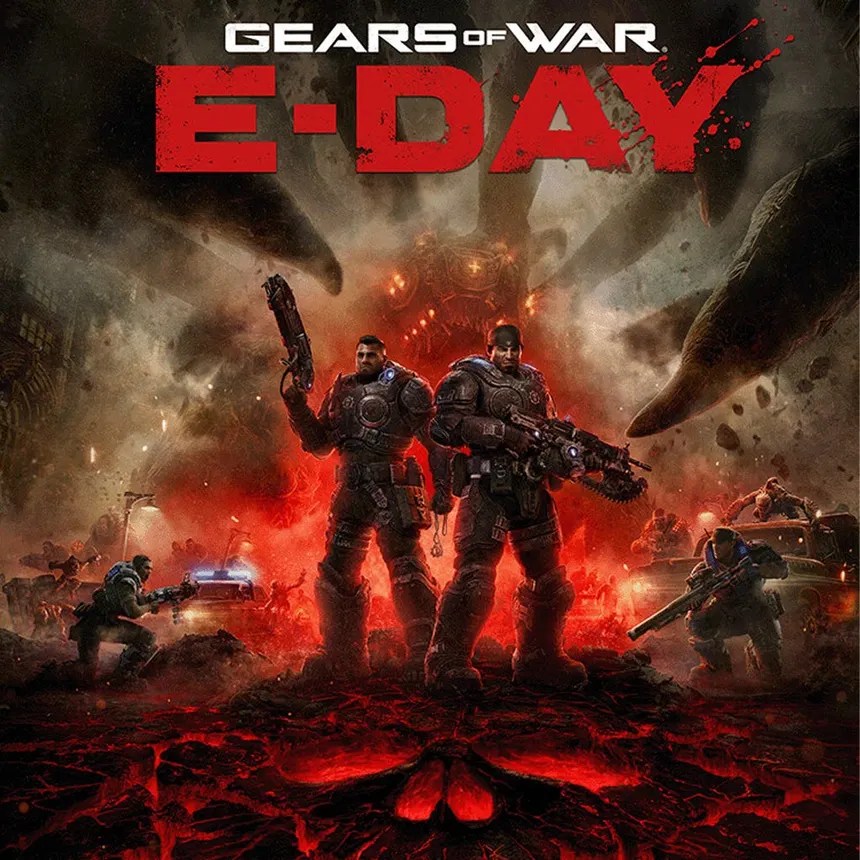
After a seemingly endless debate, a former Xbox senior product manager has offered more context for Gears of War: E-Day’s reported $500 million budget, pointing to The Coalition’s responsibility for supporting technology used beyond its own games as being the cause for the gigantic bill.
Writing on Bluesky, Derek Reese explained: “So much of that cost is The Coalition being on the hook for the Microsoft branch of Unreal and one of the flagship titles.”
Reese said he had personally tried to persuade leadership to support a plan for other studios to adopt that technology and write off the support costs. He also pointed to Turn 10 and its ForzaTech engine as another example of the same problem.
Basically, The Coalition’s responsibilities extend beyond making Marcus Fenix shoot things. It also supports Microsoft’s own branch of Unreal Engine, work which carries costs alongside developing Gears.
There’s public evidence of The Coalition helping other developers, too. Xbox Wire described in 2024 how Undead Labs had drawn on the studio’s expertise with Unreal Engine 5 while making State of Decay 3. They also appear in the credits for the likes of Avowed and Hellblade 2, all of which is counted in the $500 million price that was thrown about.
The budget debate began with Tom Henderson reporting in June that he had heard E-Day cost upwards of $400 million. Windows Central’s Jez Corden disputed that characterisation, arguing that The Coalition’s technical work across Xbox made attributing its expenditure to one game misleading.
Kotaku’s Ethan Gach subsequently reported that the figure was actually over $500 million before marketing, citing an unnamed source familiar with Xbox’s business. Microsoft did not respond to the outlet’s request for comment.
However, Corden’s response to that newer report was more specific than simply denying the amount. In an October 22 post reproduced by Push Square, he accepted the figure but said his sources disagreed over how it was allocated between E-Day, general Coalition operations and contributions to Xbox’s Advanced Technology Group.
The Game Business’ Chris Dring has also backed the amount, while explaining why game budgets need context. He recalled a producer telling him about a motion-capture facility used across three projects, whose cost was assigned to just one because it could absorb the expense. That was a separate example, not a claim about E-Day, but it illustrates why a number can be accurate while giving an incomplete impression of what it paid for.
Meanwhile, Jason Schreier described the $500 million figure as real during his recent discussion of BioWare’s closure. That supports the amount being reported, without resolving the question of which costs sit inside it.
As I noted in the original article, tools and overheads are legitimate development expenses, too. Building something for E-Day that a future Gears game also uses doesn’t automatically mean it should be removed from E-Day’s budget. Supporting other studios, though, makes judging the investment solely against Gears’ sales much more complicated.
The Verge’s Tom Warren recently reported sales of around 400,000 copies across Xbox and Steam, as covered in that earlier story. That excludes people accessing E-Day through Game Pass, and Warren couldn’t confirm whether Microsoft was satisfied with its subscription performance.
Reese hasn’t supplied a breakdown or a replacement figure for E-Day’s development cost, so I wouldn’t call this a definitive debunking of the reported budget. But if The Coalition is carrying substantial costs for technology that benefits other Xbox games, those contributions need to be considered when judging what Microsoft got for its money.
Basically, it’s a bloody headache for us enthuasists who like to talk about the industry. The $500 million claim is technically true, but it isn’t just for the development of E-Day, it’s for far more. But that may also put The Coalition at risk because on paper the company has a massive cost, while its latest game hasn’t exactly sold heaps of copies.