
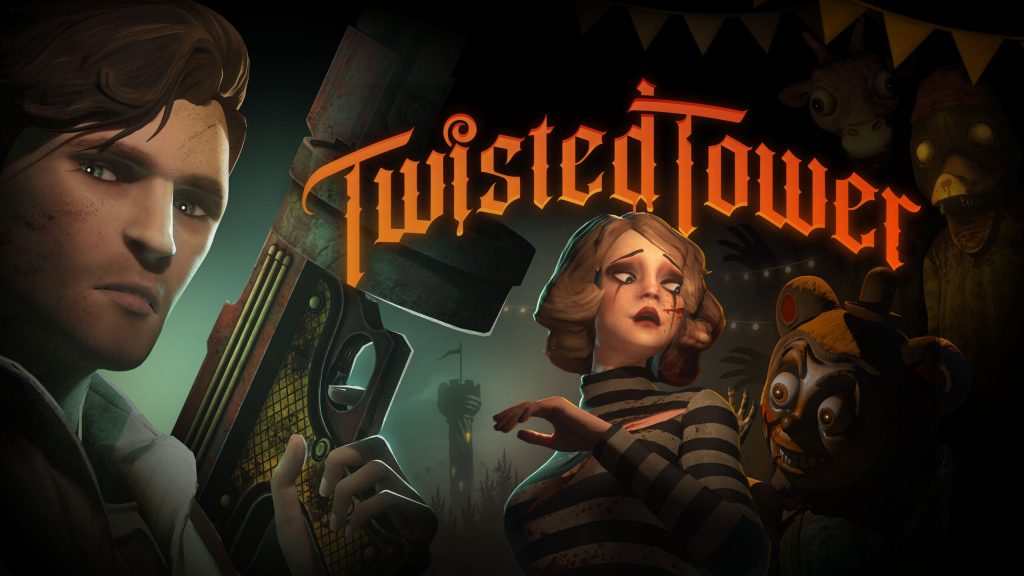
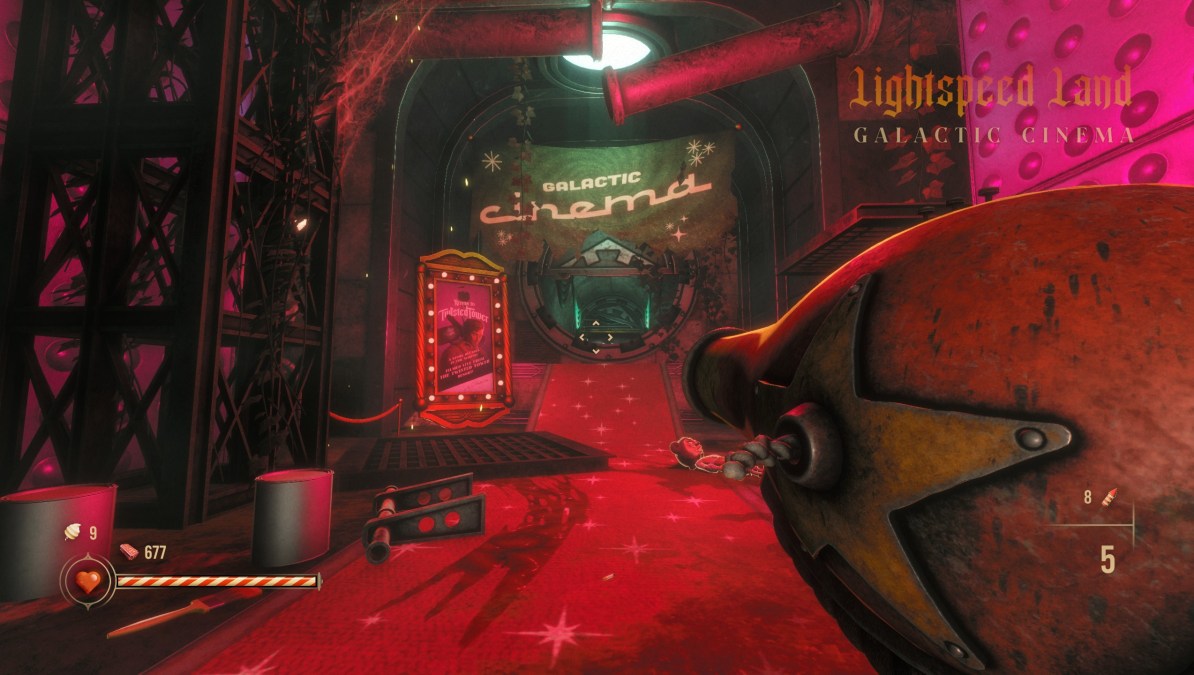
There are worse things a game can be than Temu BioShock. That sounds cruel, and perhaps it is, because Twisted Tower is clearly working with a fraction of the budget available to Irrational Games when it built Rapture. But the comparison is almost impossible to escape. From the moment you step into its rundown amusement park, surrounded by old-fashioned neon signs, abandoned attractions, strange mascots and the occasional audio log conveniently explaining somebody’s tragic past, BioShock’s fingerprints are everywhere.
REVIEW AT A GLANCE

Developer Atmos Games

Publisher 3D Realms

Reviewed On PC

Available On PC

Release Date Aug 18, 2026

Price (UK) £11.99

Genre FPS

Review Code Provided by the publisher
Quick Take:
A short, competent shooter with strong BioShock vibes, some fun enemy and weapon designs, and a story that starts intriguing before disappearing enthusiastically up its own arse.
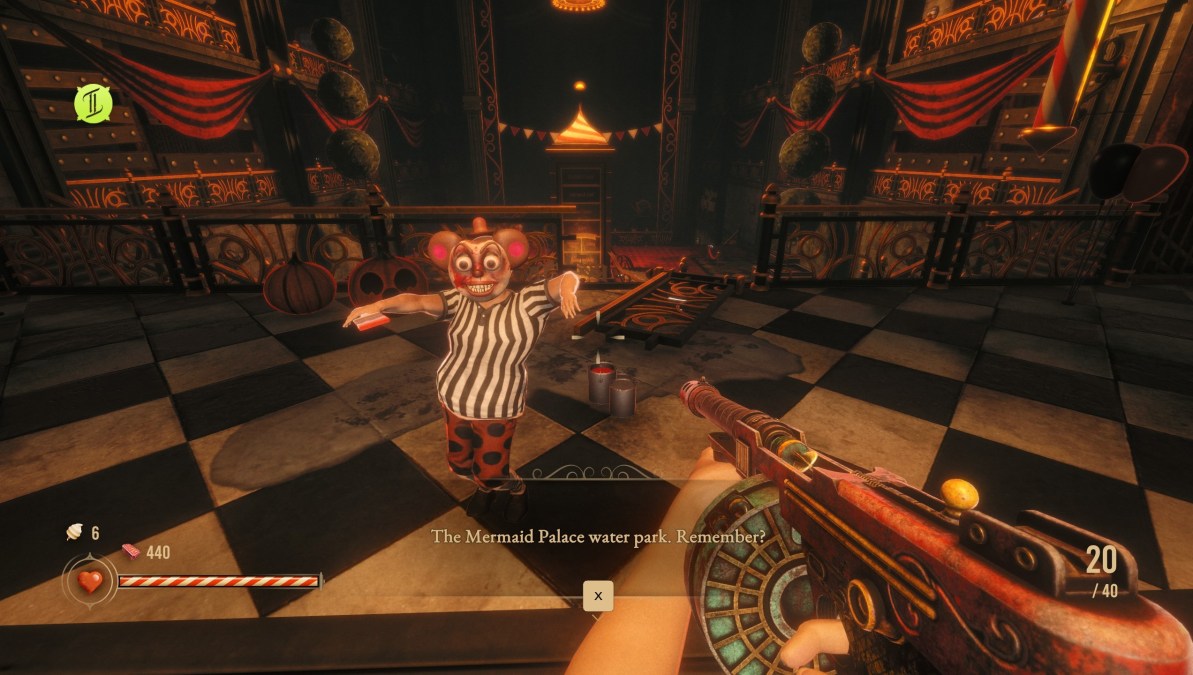
Twisted Tower doesn’t hide from the comparison, either. It wants that slightly surreal, decaying Americana atmosphere where something once designed to entertain people has become deeply unpleasant instead. There are bodies strewn around the place, lunatics wandering the corridors and enough bizarre imagery to make you wonder what exactly happened before you arrived.
Unfortunately, while it successfully mimics some of BioShock’s visual language, it rarely captures what made those environments so interesting in the first place. Or the magic of some simple words: “would you kindly?”
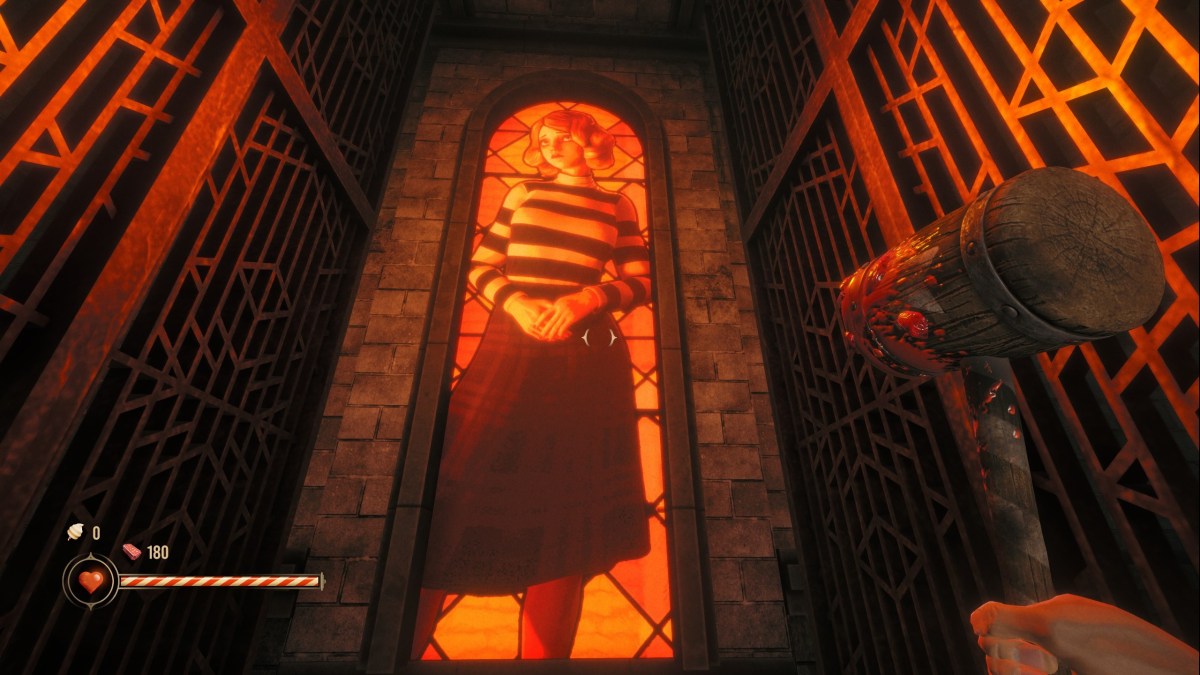
You play as Vincent Cameron, a man attempting to rescue his fiancée Charlotte after she is kidnapped by Mr. Twister, an eccentric filmmaker whose career peaked long ago and has apparently responded to failure in the healthiest possible manner: building an enormous amusement park filled with homicidal mascots. In fairness, the amusement part was built around the time of the first movie’s wild success, but after the next two movies bombed harder than Concord, it has been steadily degrading. And I didn’t want to ruin my mental health joke.
From there, the basic structure is incredibly straightforward. Vincent works his way through different sections of the tower, usually searching for a ticket, key or other item that will let him progress. Eventually you circle back to the central lobby, take the lift somewhere new and repeat the process.
Despite the name, Twisted Tower is therefore not especially twisted to navigate. It’s a very linear shooter with occasional side rooms and secret areas tucked away, but exploration is limited. You’re rarely wondering where you need to go next, and even when the game introduces characters who helpfully point Vincent in the correct direction, they’re usually telling you something you already know.
One of those characters is Piper, Vincent’s young nephew and possibly the strangest child I have encountered in a game for quite some time.
Piper wears a mask, constantly dances whenever Vincent encounters him and has the unnerving ability to rotate his head around to continue staring at you. At one point I turned around after acquiring a jetpack and discovered the little bastard breakdancing on the ceiling. Clearly, Piper is supposed to be unsettling. A demon in child form. A shadow creature hiding out as an innocent youngling, which is basically just children in general.
What makes him considerably funnier than intended is Vincent’s complete inability to react appropriately to any of this. His nephew has somehow appeared inside a tower filled with murderous creatures, is behaving like he has recently been possessed by the spirit of a particularly enthusiastic owl, and Vincent’s response basically amounts to telling him that he should probably go home.
Piper says no. Vincent decides he has done his uncle duties, and stops bothering. Look, I’m aware I’m not a shining example of a responsible uncle, but even I’d at least consider kicking the little bugger in the arse and telling him to go wait in the fucking car.
That slightly awkward disconnect between what Twisted Tower wants you to feel and what its characters actually communicate becomes increasingly important as the story progresses. There are some genuinely interesting ideas here involving Vincent’s family, his memory, his relationship with movies and Mr. Twister’s obsession with filmmaking, but the game never quite manages to pull those threads together convincingly.
There is atmosphere here. Sometimes quite a lot of it. The lighting can be lovely, particularly when coloured neon is bouncing around its grimy corridors, and the different areas change frequently enough that my roughly four-hour playthrough never became visually exhausting.
One section has a strange underwater-mermaid theme. Another revolves around a Ferris wheel. There are little roller coaster sequences and various amusement park attractions scattered throughout the place. None of them is particularly elaborate, but there’s enough variety to keep things moving. And for a game on a small budget, it’s clearly trying.
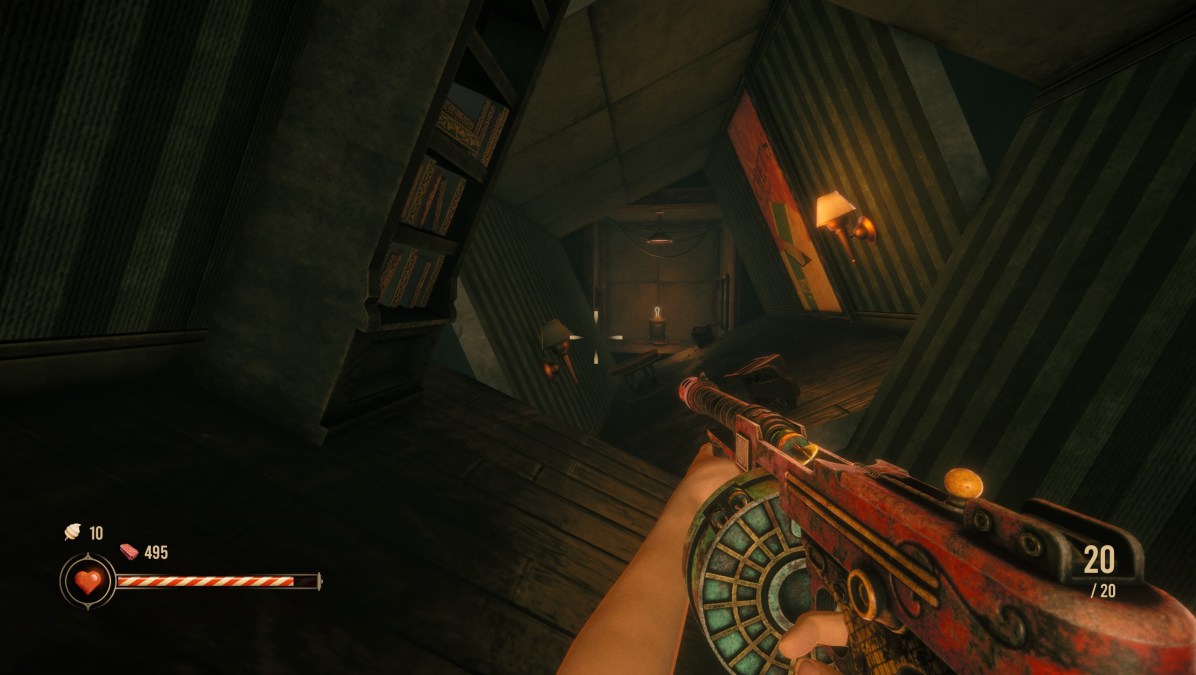
The problem is that the environments rarely seem to tell you anything. BioShock’s Rapture felt like somewhere people had actually lived before everything went catastrophically wrong. Rooms, advertisements, bodies and abandoned objects helped piece together the downfall of the place without somebody necessarily having to explain it directly.
Twisted Tower mostly looks like an abandoned horror attraction because that’s the aesthetic it has chosen. There are audio recordings and letters scattered around which provide more background on Vincent, Mr. Twister and their families, but the physical world itself rarely contributes much beyond atmosphere.
Thankfully, you spend most of your time shooting things rather than studying the wallpaper. Combat is perfectly competent, although rarely exciting. Twisted Tower is an old-fashioned, largely out-in-the-open shooter where you strafe around enemies while dumping ammunition into anything wearing a mascot costume. Since there are very few friendly NPCS, that basically means shoot at everything that moves.
The basic arsenal initially sounds remarkably predictable. Pistol. Shotgun. Tommy gun. Heavy machine gun. You know the drill.
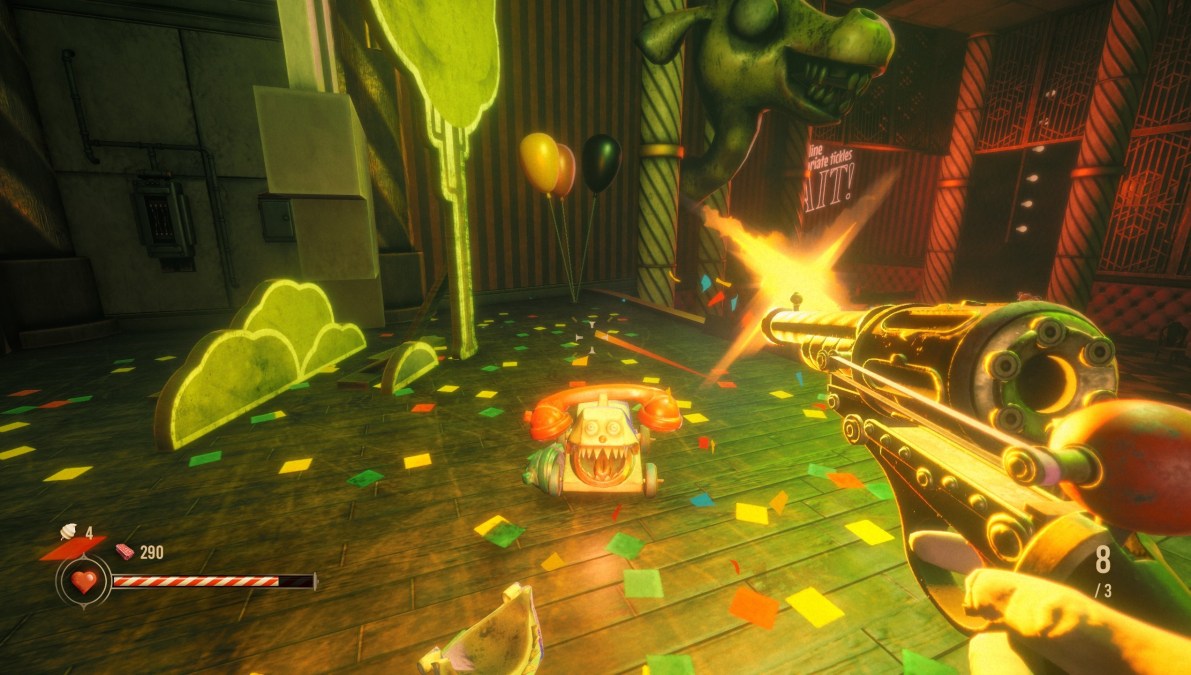
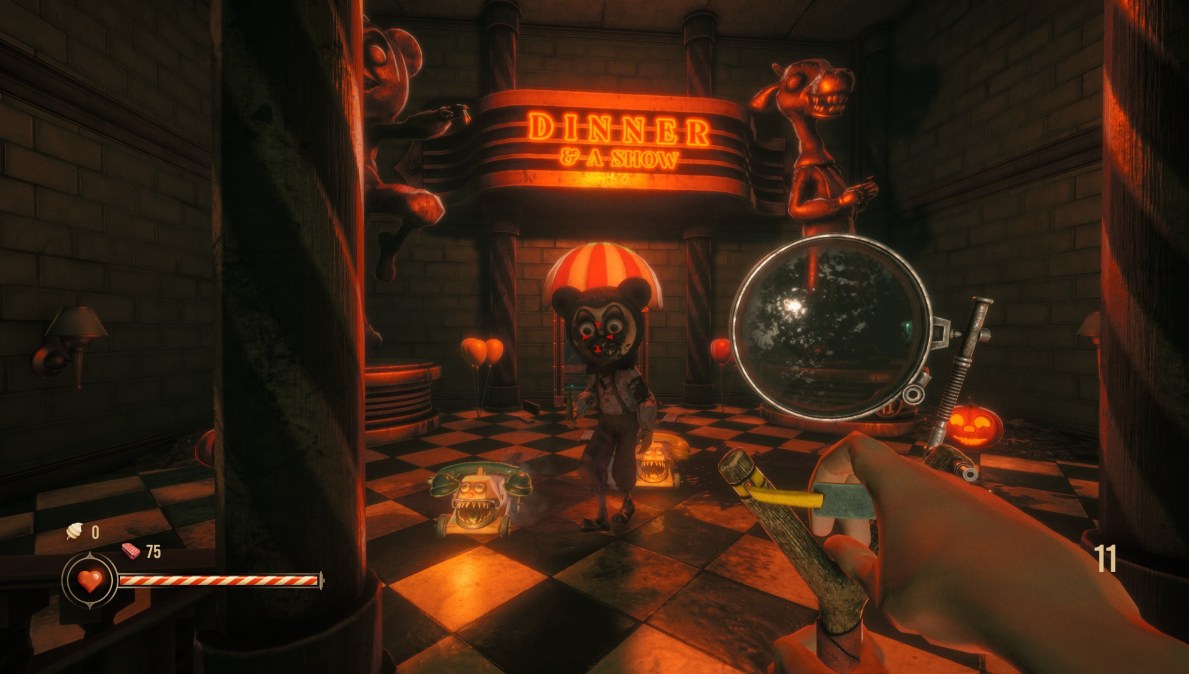
But there are some fun ideas hiding underneath those familiar categories. One weapon fires what looks like a marble and loads using a mechanism reminiscent of pinball flippers. The heavy machine gun looks like somebody welded a firearm underneath an old-fashioned sweet dispenser filled with colourful gobstopper-like ammunition. The sniper rifle is actually a slingshot with a magnifying glass.
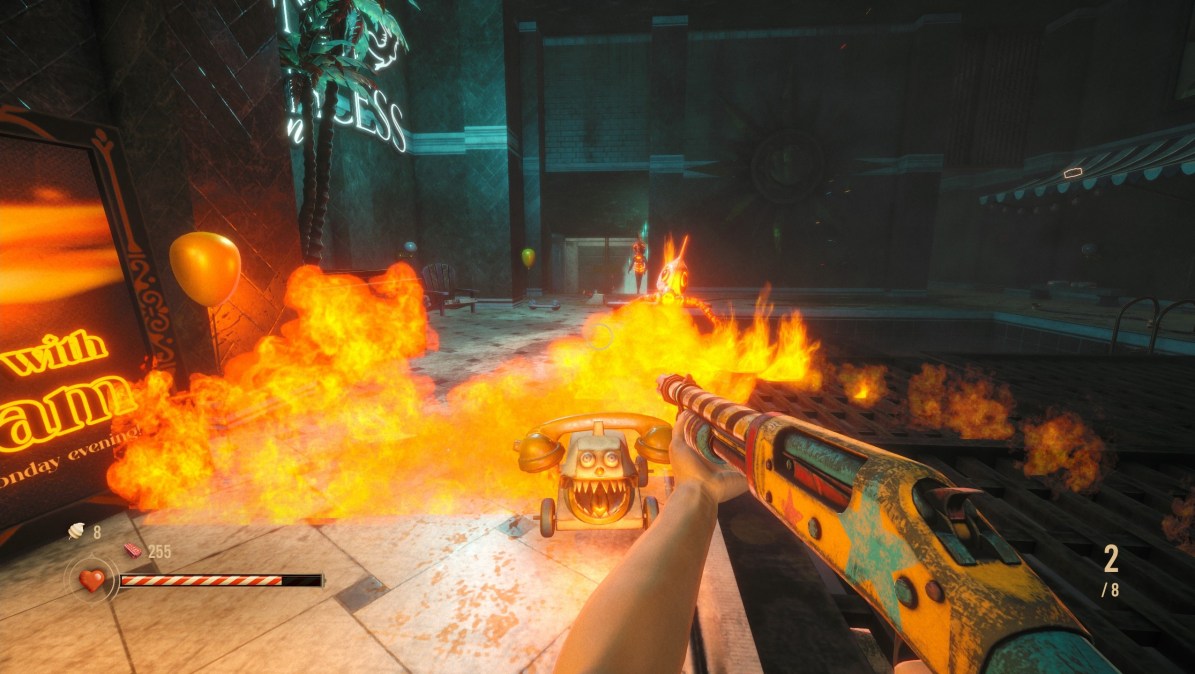
Every weapon can also be upgraded using tickets found throughout the tower, including unlocking alternate attacks. The shotgun can belch out a damaging cloud that it has just visited Taco Bell. The revolver gains a powerful special round. The Tommy gun can briefly slow time before rapidly unloading ammunition.
I rarely found myself relying on these abilities, though. Most require holding the alternate-fire button for a moment to charge them, and the regular shooting was normally more than capable of dealing with whatever was standing in front of me.
The upgrade system nevertheless provides a pleasant sense of progression, and one aspect of the combat design worked particularly well: ammunition is limited enough that I regularly had to change weapons.
That sounds like a small compliment, but plenty of shooters give you an entire armoury before accidentally encouraging you to use the same two guns for six hours. Twisted Tower’s limited ammunition meant I cycled naturally between almost everything I was carrying.
There’s a surprisingly decent selection of murderous mascots scattered around the tower. Basic masked goons eventually give way to teleporting seahorse creatures, hulking clowns carrying miniguns, floating brains armed with guns and giraffe-headed snipers. There’s also some bloody lion-headed thing that fires projectiles around itself and enormous mermaids that charge at you.
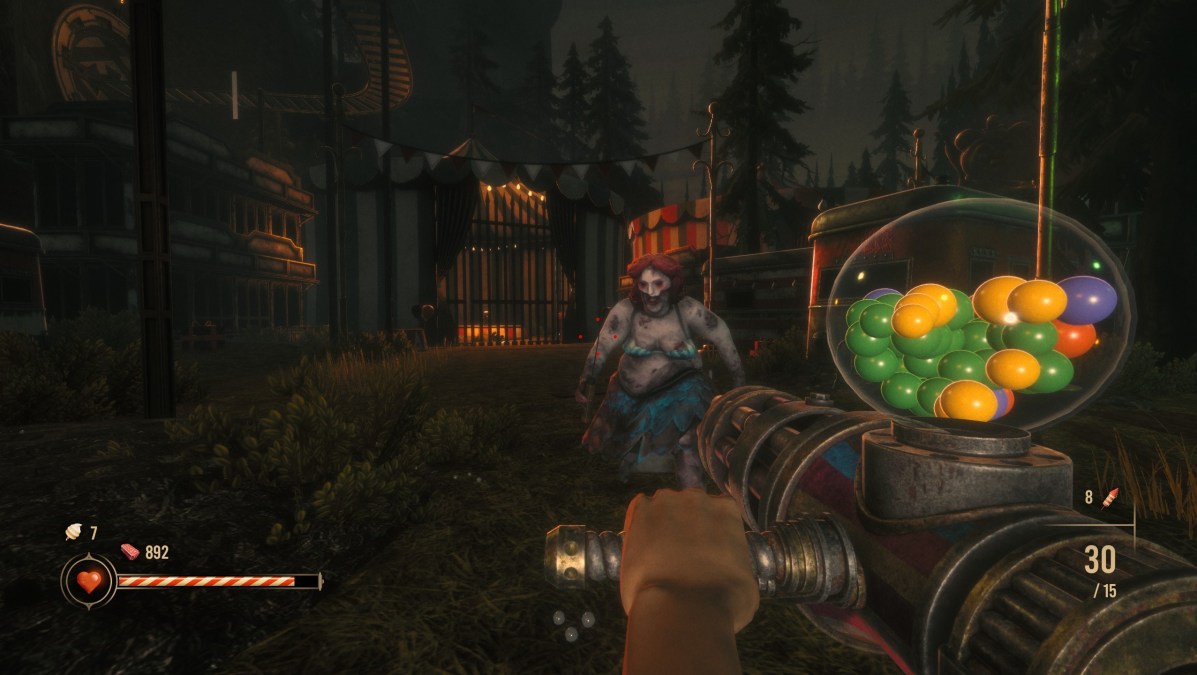
On legs. Obviously. Mermaids with tails on land would be stupid. And we would’t want to look stupid, would we?
Twisted Tower keeps introducing new enemies at a decent pace throughout its short runtime, which prevents the combat from becoming completely stale. Unfortunately, how those enemies are positioned can occasionally feel cheap.
The game absolutely loves putting something just around a corner like its Dark Souls. Enemies sometimes appear behind you, too, and there were several occasions where I took damage without really understanding what I was reasonably expected to have done differently.
The worst examples are two sequences involving hordes of spiders.
These are effectively escape sections where you are encouraged to run rather than stand around fighting, except spiders seem capable of appearing everywhere, including directly along your escape route. Because they keep arriving, wasting precious ammunition trying to kill everything feels pointless. But running didn’t work because I kept taking damage, so if I had arrived at that sequence low on health, it would have been a bloody pain in the ass.
The second encounter takes place inside a maze and manages to compound the problem. After completing the objective, a wall opens to reveal the lever required to escape. Directly behind that lever is a sentry gun which immediately opens fire. Unless you already know it exists, you are almost certainly going to take damage in the second or two it takes you to shoot the weakspot.
You then have to sprint back through the maze while spiders pour in from every direction, with the same problem as the first spider run: they can bite you from quite a distance, and there’s no way to evade the 8-legged little fuckers.
Fortunately, checkpoints are generous enough that deaths rarely became particularly irritating, and outside a single occasion where part of the game failed to load or trigger correctly, Twisted Tower ran without any notable technical problems.
Vincent gradually gains a few movement abilities as well. There’s a double jump, an air dash and eventually a grappling device that lets you pull yourself toward designated points. The grapple is presented like a gun, which briefly made me hope I was about to start firing hooks into enemies and dragging them around. Sadly not. Instead, you point it at glowing blue grapple points and press the button. Vincent flies toward them. That’s essentially the entire mechanic.
Combined with the double jump and air dash, it makes moving around slightly more enjoyable and eventually feeds into a few small platforming challenges, but none of these systems are developed enough to become a major part of the experience.
The story is where Twisted Tower takes its biggest swing, particularly during its final minutes, and discussing exactly what happens would ruin most of the fun. Suffice to say that one major revelation is incredibly easy to predict if you have eyeballs.
Another twist works considerably better because you might be able to predict it and it might be a little corny, but it fits into the story well enough. Then Twisted Tower apparently decides two twists would demonstrate an unacceptable level of restraint.
The final sequence begins throwing revelations at you so quickly that what initially looks like intentional ambiguity starts feeling more like the writers simply forgot to provide enough connective tissue for everything.
There are interesting ideas buried underneath it all. Themes involving memory, family, filmmaking and the way people can shape somebody else’s perception of reality are genuinely worth thinking about. There’s a horror vibe I appreciate, and an attempt to pull the rug out from underneath you in classic BioShock fashion.
But there is a difference between leaving carefully positioned clues for the player to assemble, and leaving enough unexplained material that the player effectively writes part of the story themselves after the credits. Twisted Tower increasingly felt like the second one.
I could construct an interpretation that makes much of the ending considerably more interesting. I could connect earlier dialogue, photographs, family relationships and Vincent’s behaviour and produce something surprisingly coherent. But I realised I was doing a suspicious amount of work on behalf of the script.
Good ambiguity makes you feel clever because you successfully connected the dots. Bad ambiguity sometimes makes you feel clever because you drew half the dots yourself, then connected them, and then ended up thinking the game was really clever.
Twisted Tower spends much of its runtime aiming for BioShock and eventually lands somewhere closer to M. Night Shyamalan having a particularly enthusiastic afternoon.
At least the performances generally sell the madness. The cast is small, but the voice acting is better than I expected from a production of this size. Vincent in particular is well performed considering some of the material he has to deliver, including his seemingly endless supply of cheesy action-movie one-liners.
The soundtrack does its job without leaving much impression, while the broader sound design and visual presentation are similarly competent. This is clearly an indie production working within limitations, and I don’t think there’s much value in criticising it simply because its environments aren’t packed with AAA-level detail.
What matters more is what it does with the resources available, and visually I think Twisted Tower acquits itself reasonably well across the roughly 3.5-5 hours it takes to battle to the top of the tower.
Completing the story also unlocks Adventure Plus, which carries progression into another run and opens alternative routes through the tower. I haven’t completed a second playthrough, so I’m not going to pretend I can judge how substantially those routes change the experience, but there is at least an explicit incentive to go around again.
In Conclusion…
Is Temu BioShock too harsh? Perhaps. But I mean it in a good way. If you’re desperate for some classic BioShock vibes, Twisted Tower might land just right.
Otherwise, it’s a competent, slightly old-school shooter with a decent atmosphere and a story that you’ll either think was written by a genius or leave wondering if you somehow missed something very important, because things get… weird. Even with the dots connected (whether real or imagined) I still felt the ending was lacking the raw writing skill needed to pull it off.
For £11.99, though, maybe I’m asking too much.

 WGB
WGB 